Ultrasonic Moulding Inserts: The Ideal Solution for Strong and Reliable Plastic Assemblies
Introduction
Plastic components have become indispensable in modern manufacturing. Industries such as automotive, consumer electronics, medical equipment, telecommunications, aerospace, and industrial automation increasingly rely on plastic parts because of their lightweight properties, design flexibility, corrosion resistance, and cost efficiency.
However, while plastics offer many advantages, they often lack the mechanical strength required for secure and long-lasting threaded fastening. Repeated tightening, vibration, high loads, and frequent assembly cycles can easily damage plastic threads, resulting in product failures and reduced lifespan.
To overcome these challenges, manufacturers use precision moulding inserts. Among the various installation methods available, ultrasonic moulding inserts have emerged as one of the most efficient and reliable solutions for creating strong threaded connections in plastic components.
Ultrasonic moulding inserts provide exceptional retention strength, superior torque resistance, and highly consistent installation, making them a preferred choice in high-volume manufacturing industries worldwide.
In this article, we will explore what ultrasonic moulding inserts are, how they work, their benefits, applications, and why they are increasingly preferred in modern plastic assemblies.
What Are Ultrasonic Moulding Inserts?
Ultrasonic moulding inserts are precision-machined metal inserts installed into thermoplastic components using ultrasonic energy.
During installation, ultrasonic vibrations generate localized heat that softens the surrounding plastic material. The insert is simultaneously pressed into the plastic, allowing the softened material to flow into the insert's knurled surface.
Once the ultrasonic energy stops, the plastic cools and solidifies, creating an extremely strong mechanical bond between the insert and the plastic component.
These inserts provide:
- Durable metal threads
- High pull-out resistance
- Excellent torque strength
- Long-term fastening reliability
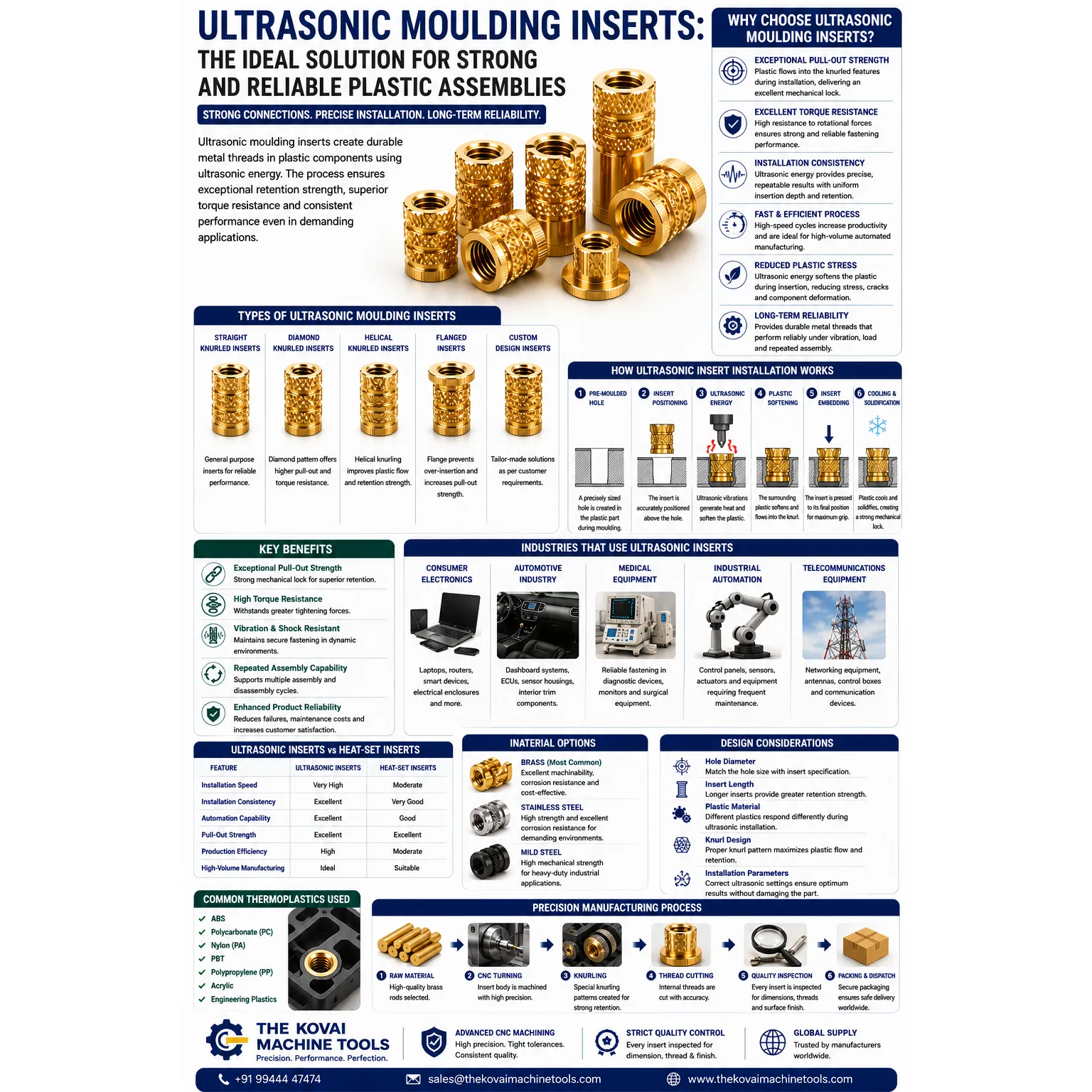
How Ultrasonic Insert Installation Works
The installation process is highly controlled and efficient.
Step 1: Pre-Moulded Hole Preparation
A precisely sized hole is created in the plastic component during moulding.
Step 2: Insert Positioning
The moulding insert is accurately positioned above the hole.
Step 3: Application of Ultrasonic Energy
An ultrasonic horn applies high-frequency vibrations to the insert.
The vibration generates frictional heat between the insert and plastic.
Step 4: Plastic Softening
The surrounding plastic softens and begins to flow around the insert's knurled surface.
Step 5: Insert Embedding
The insert is pressed to its final position.
Step 6: Cooling and Solidification
After installation, the plastic cools rapidly and solidifies around the insert, creating a secure mechanical lock.
Why Ultrasonic Installation Is Widely Preferred
Many manufacturers prefer ultrasonic insertion because it offers numerous advantages over conventional installation methods.
1. Exceptional Installation Consistency
Consistency is critical in high-volume manufacturing.
Ultrasonic systems provide:
- Controlled insertion depth
- Repeatable installation quality
- Uniform retention strength
This reduces assembly variation and improves overall product quality.
2. Superior Pull-Out Resistance
Because the plastic flows completely into the insert's knurled features, ultrasonic installation produces outstanding pull-out strength.
This ensures reliable performance even under:
- Heavy mechanical loads
- Continuous vibration
- Repeated use
3. Excellent Torque Resistance
Ultrasonically installed inserts provide superior resistance against rotational forces.
Benefits include:
- Higher tightening torque capability
- Reduced insert rotation
- Stronger fastening performance
4. Fast Production Speeds
Modern manufacturing demands high productivity.
Ultrasonic insertion offers:
- Rapid installation cycles
- Minimal downtime
- Efficient automation integration
This makes the process ideal for mass production environments.
5. Reduced Plastic Stress
Unlike force-based insertion methods, ultrasonic installation softens the plastic during insertion.
This minimizes:
- Cracking
- Stress concentration
- Component deformation
As a result, product reliability improves significantly.
Common Materials Used for Ultrasonic Inserts
Brass Ultrasonic Inserts
Brass is the most commonly used material due to:
- Excellent machinability
- Superior thermal conductivity
- Corrosion resistance
- Cost-effectiveness
Brass inserts are widely used across multiple industries.
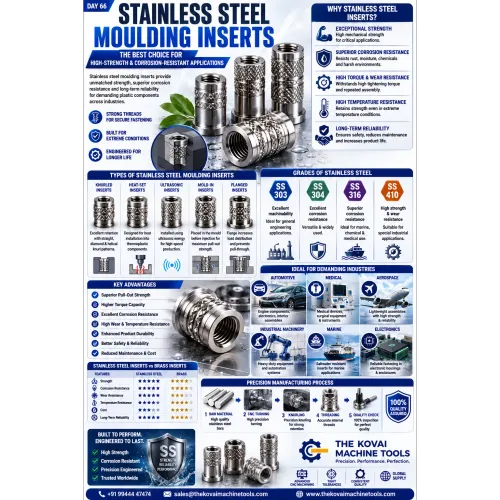
Stainless Steel Ultrasonic Inserts
Used in applications requiring:
- High mechanical strength
- Extreme corrosion resistance
- High-temperature performance
Mild Steel Ultrasonic Inserts
Suitable for heavy-duty industrial applications requiring high strength.
Types of Ultrasonic Moulding Inserts
Different applications require different insert designs.
Straight Knurled Inserts
Provide reliable grip in standard applications.
Diamond Knurled Inserts
Offer enhanced retention and torque resistance.
Helical Knurled Inserts
Improve plastic flow during installation and maximize bonding strength.
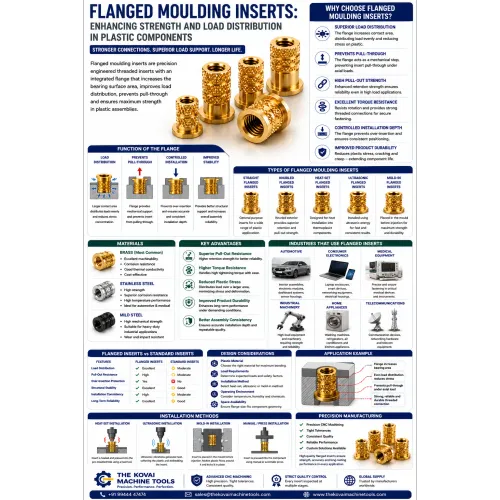
Flanged Inserts
Include a flange that prevents over-insertion and increases pull-out resistance.
Industries Using Ultrasonic Moulding Inserts
Consumer Electronics
Applications include:
- Laptop housings
- Networking equipment
- Smart devices
- Electrical enclosures
Ultrasonic inserts provide durable fastening in compact products.
Automotive Industry
Automotive manufacturers use ultrasonic inserts in:
- Dashboard assemblies
- Electronic control units
- Sensor housings
- Interior plastic components
Their vibration resistance is particularly valuable in vehicle applications.
Medical Equipment
Medical devices demand precision and reliability.
Ultrasonic inserts ensure secure fastening in critical assemblies.
Industrial Automation
Automation systems require components capable of repeated maintenance and service.
Ultrasonic inserts provide long-term thread durability.
Telecommunications Equipment
Reliable fastening is essential for networking and communication devices.
Ultrasonic inserts support long operational life.
Ultrasonic Inserts vs Heat-Set Inserts
FeatureUltrasonic InsertsHeat-Set InsertsInstallation SpeedVery HighModerateAutomation CapabilityExcellentGoodInstallation ConsistencyExcellentVery GoodPull-Out StrengthExcellentExcellentProduction EfficiencyHighModerateHigh-Volume ManufacturingIdealSuitable
Both methods offer excellent performance, but ultrasonic installation is often preferred in automated, high-volume production environments.
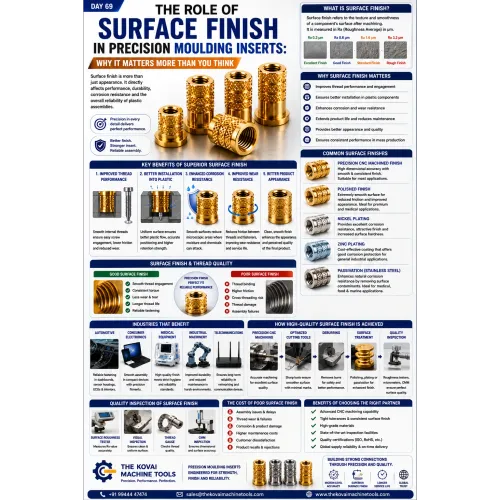
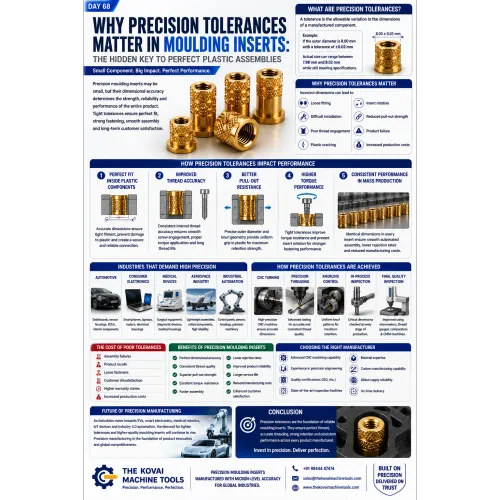
Importance of Precision Manufacturing
The performance of ultrasonic moulding inserts depends heavily on manufacturing precision.
High-quality inserts require:
- Accurate dimensions
- Precise thread profiles
- Consistent knurling
- Tight tolerances
- Excellent surface finish
Advanced CNC machining ensures that every insert performs reliably.
Poor-quality inserts may cause:
- Installation issues
- Weak retention
- Thread failures
- Reduced product lifespan
Therefore, choosing an experienced precision insert manufacturer is essential.
Future of Ultrasonic Moulding Inserts
As industries increasingly adopt:
- Lightweight products
- Compact electronic devices
- Smart technologies
- Electric vehicles
- Automated manufacturing
The demand for ultrasonic moulding inserts will continue to grow.
Their combination of strength, installation speed, and manufacturing efficiency makes them a key fastening solution for future product designs.
Conclusion
Ultrasonic moulding inserts provide one of the most reliable and efficient methods for creating strong threaded connections in plastic components.
Their superior pull-out resistance, excellent torque performance, fast installation, and consistent quality make them the preferred choice for manufacturers worldwide.
From consumer electronics and automotive systems to medical devices and industrial automation, ultrasonic inserts play a vital role in ensuring durable, long-lasting, and high-performance plastic assemblies.
As manufacturing technologies continue to advance, ultrasonic moulding inserts will remain an essential component in precision engineering.
Call to Action
Looking for high-quality ultrasonic moulding inserts, brass inserts, or custom precision CNC turned components?
The Kovai Machine Tools specializes in manufacturing premium precision moulding inserts designed for superior retention, durability, and long-term performance.
With advanced CNC machining capabilities, strict quality control, and extensive industry expertise, we deliver precision-engineered components trusted by manufacturers worldwide.
📞 Contact us today to discuss your ultrasonic moulding insert requirements and receive a customized solution tailored to your application.
The Kovai Machine Tools – Your Trusted Global Partner for Precision Moulding Inserts and CNC Turned Components. 🚀
Keywords