OEMs Choose Custom Brass Moulding Inserts Over Standard Inserts
Introduction
In today's highly competitive manufacturing landscape, Original Equipment Manufacturers (OEMs) are under constant pressure to improve product quality, reduce assembly time, enhance durability, and optimize production costs. Whether manufacturing automotive components, electrical equipment, consumer electronics, medical devices, industrial machinery, or smart appliances, every component used in the final product plays a crucial role in overall performance.
One such critical component is the brass moulding insert.
While standard moulding inserts are widely available and suitable for general applications, many OEMs increasingly prefer custom brass moulding inserts specifically designed to match their product requirements.
Why?
Because every product is unique. Different plastic materials, assembly methods, load conditions, space constraints, and performance requirements often demand a customized fastening solution rather than a one-size-fits-all insert.
Custom brass moulding inserts provide OEMs with greater design flexibility, improved product performance, enhanced assembly efficiency, and long-term reliability.
In this article, we will explore why OEMs worldwide prefer custom brass moulding inserts over standard inserts and how customized insert solutions contribute to better product outcomes.
Understanding Brass Moulding Inserts
Brass moulding inserts are precision-machined metal components embedded into plastic parts to create durable threaded connections.
These inserts provide:
- Strong internal threads
- Improved fastening strength
- Resistance to thread wear
- Better load distribution
- Long-term durability
They are commonly manufactured using precision CNC turning processes and installed using:
- Heat-set methods
- Ultrasonic insertion
- Press-fit installation
- Injection moulding processes
While standard inserts serve many applications, OEMs often require more specialized solutions.
What Are Custom Brass Moulding Inserts?
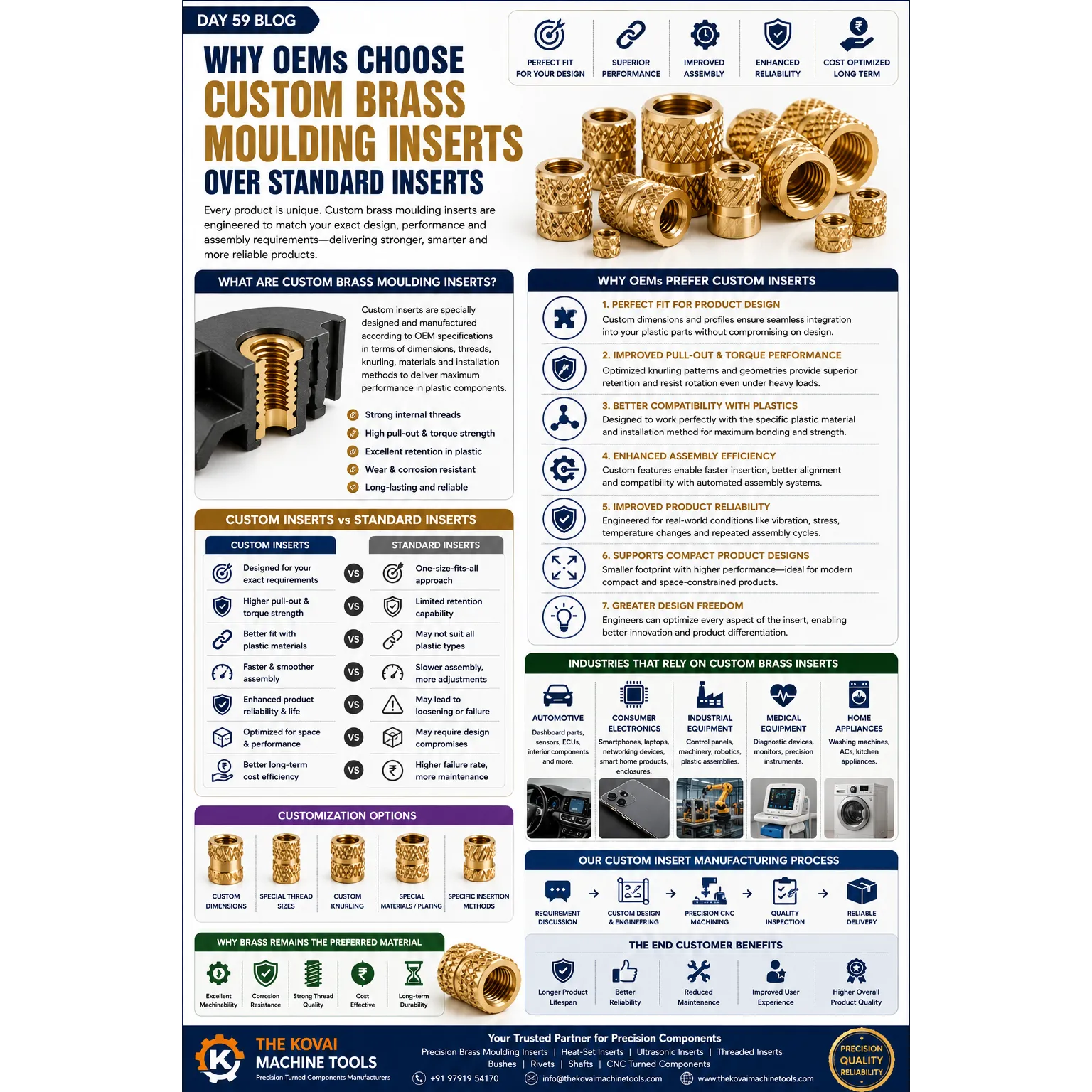
Custom brass moulding inserts are inserts specifically engineered according to the OEM's design requirements.
Customization can include:
- Unique dimensions
- Special thread sizes
- Custom knurling patterns
- Special materials or plating
- Specific insertion methods
- Enhanced retention features
Rather than adapting the product to fit a standard insert, OEMs can design the insert to perfectly match the product.
This approach significantly improves overall product performance.
Why OEMs Prefer Custom Brass Moulding Inserts
1. Perfect Fit for Product Design
Every product has unique design requirements.
Standard inserts may require design compromises, such as:
- Increased wall thickness
- Larger component size
- Modified plastic geometry
Custom inserts eliminate these limitations.
OEMs can specify:
- Exact diameter
- Length
- Thread size
- Knurl design
- Retention features
This ensures seamless integration into the plastic component.
End Customer Benefit
Products become more compact, stronger, and better engineered.
2. Improved Pull-Out and Torque Performance
One of the primary reasons OEMs choose custom inserts is to achieve specific retention performance.
Different applications require different levels of:
- Pull-out resistance
- Torque resistance
- Anti-rotation capability
By customizing the knurl pattern and geometry, manufacturers can significantly improve insert retention.
End Customer Benefit
Products remain durable and reliable even under heavy use.
3. Better Compatibility with Plastic Materials
Not all plastics behave the same way.
Common engineering plastics include:
- ABS
- Nylon
- Polycarbonate
- PBT
- Polypropylene
- Glass-filled polymers
Each material responds differently during insert installation.
Custom brass inserts can be optimized to suit specific plastic materials.
This ensures:
- Better bonding
- Reduced stress
- Improved retention
End Customer Benefit
Longer product life and fewer failures.
4. Enhanced Assembly Efficiency
OEMs constantly seek ways to reduce production time.
Custom inserts can be designed for:
- Faster insertion
- Better alignment
- Automated assembly systems
- Reduced installation errors
This improves manufacturing productivity and lowers assembly costs.
End Customer Benefit
More consistent product quality and reduced manufacturing defects.
5. Improved Product Reliability
Product failures often originate from weak fastening systems.
Custom brass moulding inserts are designed specifically for the intended operating conditions.
This allows OEMs to address:
- Vibration
- Mechanical stress
- Temperature changes
- Repeated assembly cycles
End Customer Benefit
Greater reliability and reduced maintenance requirements.
6. Support for Compact Product Designs
Modern products are becoming increasingly compact.
Industries such as electronics and medical devices often have limited installation space.
Custom inserts can be designed to provide:
- Maximum retention
- Minimal footprint
- Lightweight construction
This allows engineers to optimize product size without compromising performance.
End Customer Benefit
Smaller, lighter, and more efficient products.
7. Greater Design Freedom for Engineers
Standard inserts sometimes limit engineering creativity.
Custom inserts allow product designers to optimize every aspect of the assembly.
This includes:
- Thread engagement length
- Insert profile
- Knurl configuration
- Installation method
The result is a better overall product design.
End Customer Benefit
Higher-performing products with superior functionality.
Industries That Rely on Custom Brass Moulding Inserts
Automotive Industry
Automotive OEMs use custom inserts in:
- Dashboard assemblies
- Electronic control units
- Sensor housings
- Interior trim components
Custom designs help withstand vibration and thermal expansion.
Consumer Electronics
Electronic devices require compact and precise fastening solutions.
Applications include:
- Smartphones
- Smart home devices
- Networking equipment
- Electrical enclosures
Custom inserts support miniaturized designs.
Medical Equipment
Medical device manufacturers require precision and reliability.
Custom inserts provide:
- Accurate fit
- Consistent performance
- Long service life
Critical for healthcare applications.
Industrial Equipment
Industrial OEMs often require heavy-duty fastening systems.
Custom inserts provide enhanced retention and durability in demanding environments.
The Role of Precision CNC Manufacturing
Custom moulding inserts require high levels of precision.
Advanced CNC machining ensures:
- Tight tolerances
- Accurate thread profiles
- Consistent dimensions
- Precision knurling
Without precision manufacturing, even the best custom design can fail to achieve the desired performance.
This is why OEMs partner with experienced manufacturers that specialize in precision brass insert production.
Why Brass Remains the Preferred Material
Brass continues to dominate the moulding insert industry because it offers:
Excellent Machinability
Allows production of complex custom designs.
Corrosion Resistance
Suitable for a wide range of operating environments.
Strong Thread Quality
Provides smooth and durable fastening.
Cost Efficiency
Offers excellent value compared to many alternative materials.
These advantages make brass the ideal material for customized insert solutions.
How Custom Inserts Create Value for End Customers
Although end users may never see the insert inside the product, they experience the benefits every day.
Longer Product Lifespan
Stronger fastening systems increase durability.
Better Reliability
Components remain secure throughout the product lifecycle.
Reduced Maintenance
Fewer failures mean fewer repairs.
Improved User Experience
Products feel more robust and dependable.
Future Trends in Custom Moulding Inserts
As products become more advanced, OEM demand for custom insert solutions continues to grow.
Future trends include:
- Miniaturized inserts
- High-performance engineering plastics
- Automated assembly integration
- Advanced knurling geometries
- Industry-specific insert designs
Manufacturers capable of producing precision custom inserts will play a critical role in supporting these innovations.
Conclusion
While standard moulding inserts remain useful for many applications, OEMs increasingly choose custom brass moulding inserts to achieve superior product performance, design flexibility, and manufacturing efficiency.
Custom inserts allow engineers to optimize retention strength, assembly speed, product reliability, and compatibility with specific plastic materials.
As industries continue to innovate and demand higher-performance products, customized brass moulding inserts will remain an essential solution for modern manufacturing.
Call to Action
Looking for custom brass moulding inserts designed specifically for your product requirements?
The Kovai Machine Tools specializes in manufacturing precision custom brass moulding inserts, heat-set inserts, ultrasonic inserts, threaded inserts, bushes, rivets, shafts, and CNC turned components for OEMs worldwide.
Our capabilities include:
✅ Custom insert design and development
✅ Precision CNC machining
✅ High-quality brass materials
✅ Custom knurling and thread profiles
✅ Consistent quality and global supply support
📞 Contact us today to discuss your custom moulding insert requirements and request a tailored quotation.
Partner with The Kovai Machine Tools and give your products the advantage of precision-engineered custom brass moulding inserts built for performance and reliability. 🚀
Keywords