Heat-Set Brass Inserts: The Preferred Choice for High-Strength Plastic Assemblies
Introduction
Modern product design increasingly relies on plastic components because they are lightweight, corrosion-resistant, cost-effective, and highly versatile. Industries such as automotive, consumer electronics, medical devices, electrical equipment, telecommunications, and industrial machinery extensively use engineered plastics in their products.
However, one major challenge remains: creating strong and durable threaded connections in plastic parts.
Plastic threads alone often struggle to withstand repeated assembly, high torque loads, vibration, and long-term operational stress. Over time, plastic threads can wear out, strip, crack, or lose their holding strength.
To overcome these limitations, manufacturers use heat-set brass inserts.
Heat-set brass inserts have become one of the most preferred fastening solutions for plastic assemblies because they provide durable metal threads permanently embedded into plastic components. They offer exceptional pull-out resistance, torque performance, and long-term reliability.
For OEMs and product designers worldwide, heat-set brass inserts are often the first choice when designing high-strength plastic assemblies.
In this article, we will explore why heat-set brass inserts are preferred across industries, how they work, their advantages, applications, and the benefits they bring to end users.
What Are Heat-Set Brass Inserts?
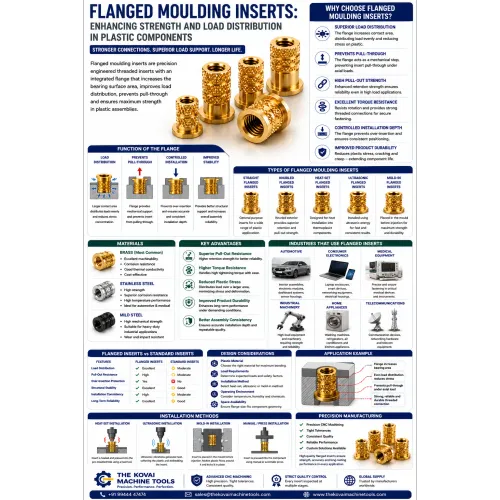
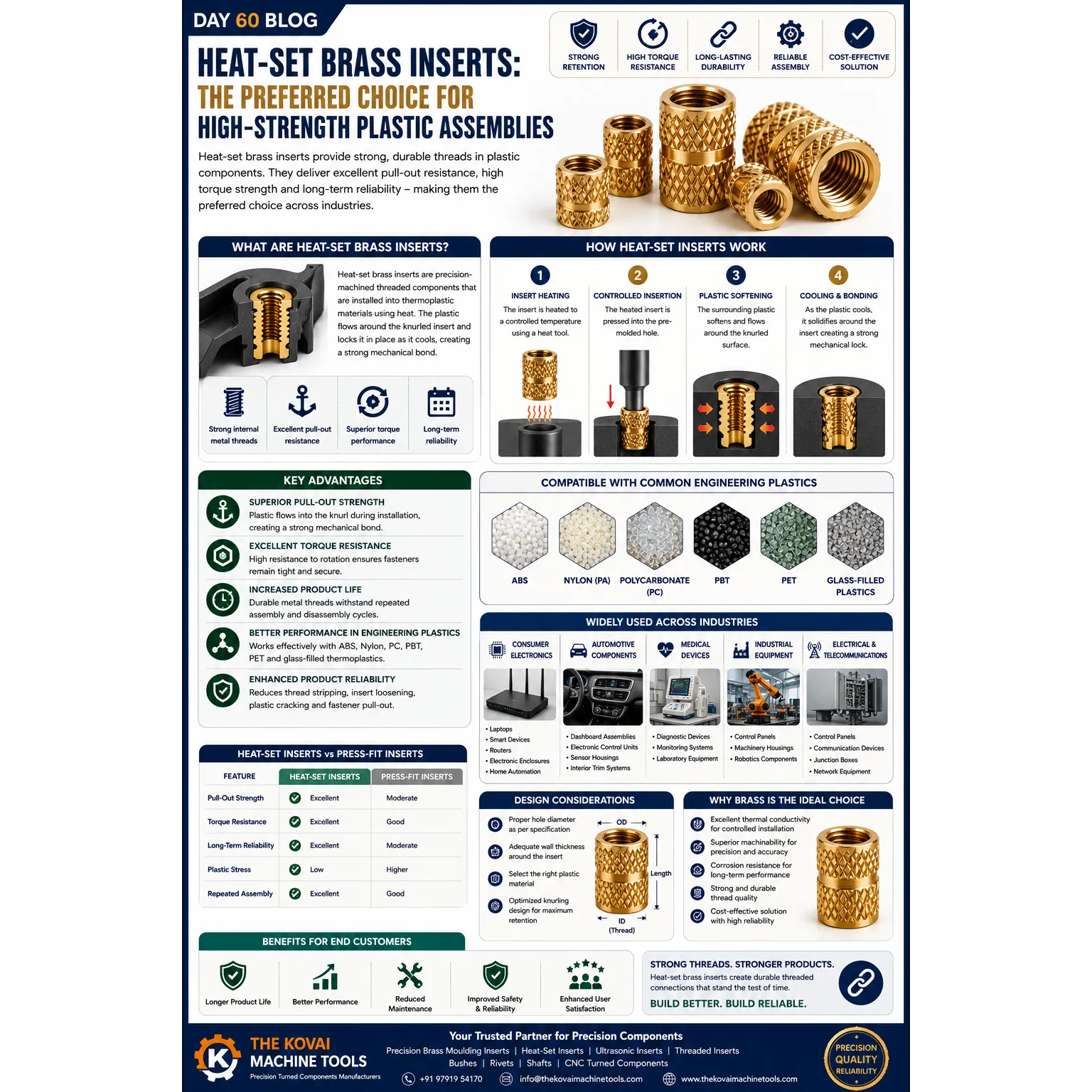
Heat-set brass inserts are precision-machined threaded components designed to be permanently installed into thermoplastic materials using heat.
Unlike press-fit inserts, which rely solely on mechanical force, heat-set inserts are installed by heating the insert and allowing it to melt slightly into the surrounding plastic.
As the plastic cools and solidifies around the insert's knurled exterior, it creates a strong mechanical bond.
The result is:
- Strong internal metal threads
- Superior retention strength
- Excellent resistance to pull-out
- Enhanced torque performance
- Long-lasting durability
Heat-set inserts are most commonly manufactured from brass because of its excellent thermal conductivity and machining characteristics.
How Heat-Set Brass Inserts Work
The installation process is relatively simple yet highly effective.
Step 1: Insert Heating
A specialized heat installation tool heats the brass insert to a controlled temperature.
Step 2: Controlled Insertion
The heated insert is pressed into a pre-molded hole in the plastic component.
Step 3: Plastic Softening
The surrounding plastic softens and flows around the knurled surface of the insert.
Step 4: Cooling and Bonding
As the plastic cools, it solidifies around the insert, creating a secure mechanical lock.
This process creates significantly stronger retention compared to simple press-fit methods.
Why Brass Is the Ideal Material for Heat-Set Inserts
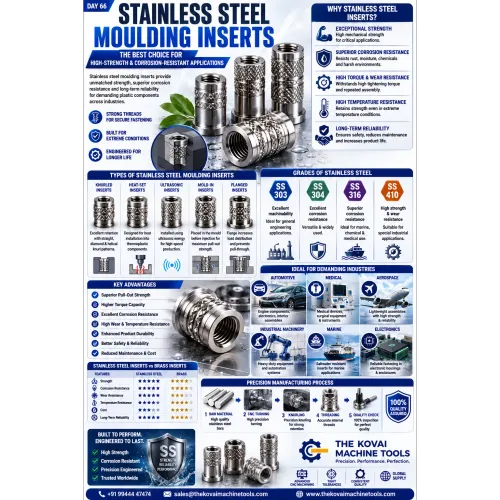
Among all engineering metals, brass remains the preferred material for heat-set inserts.
Excellent Thermal Conductivity
Brass transfers heat efficiently, enabling controlled installation without damaging the plastic.
Precision Machinability
Brass can be machined with exceptional accuracy, allowing manufacturers to create:
- Precise thread profiles
- Consistent knurling patterns
- Tight tolerances
Corrosion Resistance
Brass offers excellent resistance to moisture and environmental exposure.
Durable Thread Performance
Brass threads provide long-term reliability even after repeated assembly cycles.
Key Advantages of Heat-Set Brass Inserts
1. Superior Pull-Out Strength
One of the biggest reasons manufacturers prefer heat-set inserts is their exceptional pull-out resistance.
Because the plastic flows around the knurled surface during installation, the insert becomes firmly anchored inside the component.
End Customer Benefit
Products remain secure and durable even under heavy usage.
2. Excellent Torque Resistance
When screws are tightened into an insert, rotational forces are transferred to the insert body.
Heat-set inserts provide superior resistance to rotation because of their strong mechanical bond with the plastic.
End Customer Benefit
Fasteners remain tight and reliable throughout the product's lifespan.
3. Increased Product Life
Plastic threads can wear out after repeated assembly and disassembly.
Heat-set brass inserts provide durable metal threads capable of handling thousands of fastening cycles.
End Customer Benefit
Longer-lasting products with fewer maintenance issues.
4. Better Performance in Engineering Plastics
Heat-set inserts work exceptionally well with:
- ABS
- Nylon
- Polycarbonate
- PBT
- PET
- Glass-filled thermoplastics
These materials are widely used in high-performance industrial products.
End Customer Benefit
Greater reliability in demanding environments.
5. Enhanced Product Reliability
Heat-set inserts significantly reduce common failure modes such as:
- Thread stripping
- Insert loosening
- Plastic cracking
- Fastener pull-out
End Customer Benefit
Improved product safety and reliability.
Common Applications of Heat-Set Brass Inserts
Consumer Electronics
Heat-set inserts are widely used in:
- Laptops
- Smart devices
- Routers
- Electronic enclosures
- Home automation products
They allow repeated assembly without damaging plastic housings.
Automotive Components
Automotive manufacturers use heat-set inserts in:
- Dashboard assemblies
- Electronic control units
- Sensor housings
- Interior trim systems
Their vibration resistance makes them ideal for vehicle applications.
Medical Devices
Medical equipment requires secure fastening and long service life.
Heat-set inserts are commonly found in:
- Diagnostic devices
- Monitoring systems
- Laboratory equipment
Industrial Equipment
Industrial machinery often uses reinforced plastic components that require durable threaded connections.
Heat-set inserts provide the necessary strength and reliability.
Electrical and Telecommunications Equipment
Applications include:
- Control panels
- Communication devices
- Junction boxes
- Network equipment
Design Considerations for Heat-Set Inserts
Proper design is critical for achieving optimal performance.
Important factors include:
Hole Diameter
The installation hole must be designed according to insert specifications.
Wall Thickness
Adequate plastic material should surround the insert.
Plastic Material Selection
Different plastics behave differently during installation.
Knurling Design
The insert's knurled surface must be optimized for maximum retention.
Why OEMs Prefer Heat-Set Inserts Over Press-Fit Inserts
While both methods have advantages, heat-set inserts generally provide:
FeatureHeat-Set InsertsPress-Fit InsertsPull-Out StrengthExcellentModerateTorque ResistanceExcellentGoodLong-Term ReliabilityExcellentModeratePlastic StressLowHigherRepeated AssemblyExcellentGood
For high-performance applications, OEMs often select heat-set inserts because of their superior mechanical properties.
The Importance of Precision Manufacturing
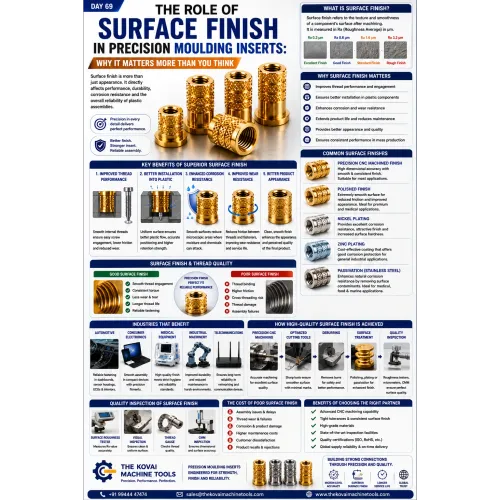
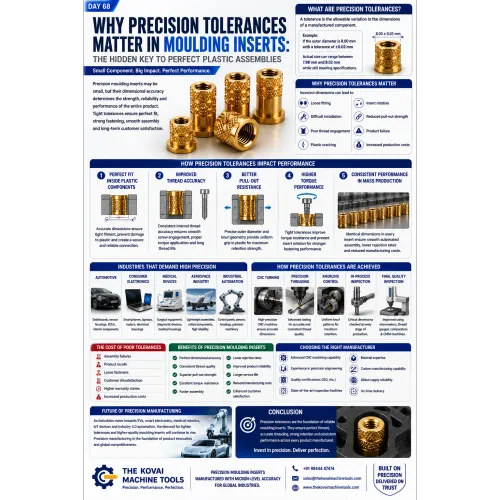
The effectiveness of a heat-set insert depends heavily on manufacturing quality.
High-quality inserts require:
- Precision CNC machining
- Accurate thread profiles
- Uniform knurling patterns
- Consistent dimensions
Even minor variations can affect installation quality and long-term performance.
This is why leading manufacturers rely on experienced precision machining partners.
Future Growth of Heat-Set Insert Technology
As industries continue to adopt lightweight plastics and compact product designs, the demand for heat-set inserts continues to grow.
Future trends include:
- Miniaturized inserts for electronics
- High-performance engineered plastics
- Automated installation systems
- Advanced retention geometries
- Smart manufacturing integration
Heat-set inserts will continue to play a critical role in next-generation product design.
Conclusion
Heat-set brass inserts have become the preferred fastening solution for high-strength plastic assemblies because they offer superior pull-out resistance, exceptional torque performance, and long-term durability.
Their ability to create strong metal threads within plastic components makes them indispensable in industries ranging from automotive and electronics to medical devices and industrial equipment.
For OEMs seeking reliable fastening solutions and long-lasting product performance, heat-set brass inserts remain one of the most effective engineering choices available.
Call to Action
Looking for high-quality heat-set brass inserts manufactured to international standards?
The Kovai Machine Tools specializes in precision brass moulding inserts, heat-set inserts, ultrasonic inserts, threaded inserts, bushes, rivets, shafts, and custom CNC turned components for industries worldwide.
Our strengths include:
✅ Precision CNC manufacturing
✅ Superior knurling and retention design
✅ Consistent thread quality
✅ Custom insert development
✅ Reliable global supply support
📞 Contact us today to discuss your heat-set insert requirements and request a customized quotation.
Partner with The Kovai Machine Tools and strengthen your plastic assemblies with precision-engineered heat-set brass inserts designed for long-term performance and reliability. 🚀
Keywords