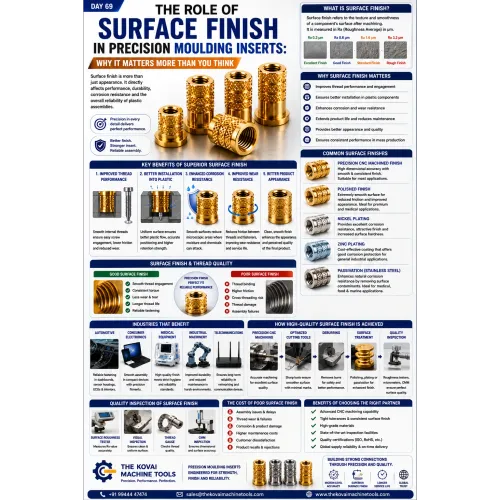
The Role of Surface Finish in Precision Moulding Inserts: Why It Matters More Than You Think
Introduction
In precision manufacturing, every detail matters. While factors such as material selection, dimensional accuracy, thread quality, and knurl design receive significant attention, one equally important aspect is often overlooked—the surface finish of the moulding insert.
Surface finish is much more than the appearance of a metal component. It directly affects the insert's performance, durability, corrosion resistance, installation quality, and the overall reliability of the plastic assembly.
Whether a moulding insert is used in an automotive dashboard, a medical device, an industrial control panel, or a consumer electronic product, the quality of its surface plays a vital role in ensuring consistent performance over the product's lifetime.
For manufacturers across the globe, investing in precision moulding inserts with superior surface finishes leads to fewer assembly issues, improved product quality, lower maintenance costs, and greater customer satisfaction.
In this article, we'll explore why surface finish is critical in precision moulding inserts, the different types of finishes, their benefits, and how they contribute to high-quality plastic assemblies.
What Is Surface Finish?
Surface finish refers to the texture, smoothness, and overall quality of a component's external and internal surfaces after machining.
It is determined by factors such as:
- CNC machining accuracy
- Cutting tool quality
- Machining parameters
- Material properties
- Post-machining processes
Surface finish is typically measured in Ra (Roughness Average), expressed in micrometers (µm).
A lower Ra value indicates a smoother surface, while a higher value represents a rougher texture.
Why Surface Finish Matters in Moulding Inserts
Although moulding inserts are relatively small components, their surface quality directly impacts their performance in plastic assemblies.
A high-quality surface finish provides:
- Better thread engagement
- Improved installation
- Enhanced corrosion resistance
- Longer service life
- Superior appearance
- Consistent manufacturing quality
1. Improved Thread Performance
The internal threads of a moulding insert must allow smooth engagement with screws or bolts.
A superior surface finish ensures:
- Easy screw insertion
- Reduced friction
- Lower thread wear
- Consistent tightening torque
Poor surface quality may result in:
- Thread binding
- Cross-threading
- Increased assembly time
- Premature thread damage
2. Better Installation into Plastic Components
Whether using:
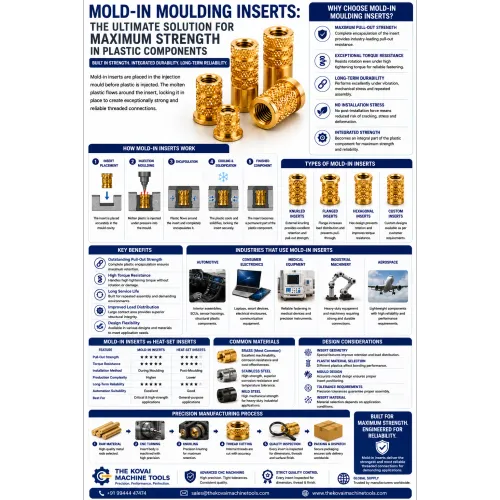
- Heat-set inserts
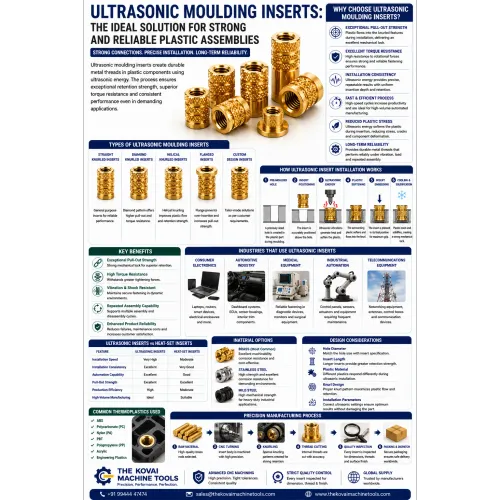
- Ultrasonic inserts
- Mold-in inserts
- Press-fit inserts
A properly finished insert ensures consistent interaction with the surrounding plastic.
Uniform surfaces improve:
- Plastic flow
- Insert positioning
- Retention strength
- Assembly consistency
3. Enhanced Corrosion Resistance
Surface finish significantly influences corrosion performance.
Smooth surfaces reduce microscopic imperfections where:
- Moisture accumulates
- Chemicals attack
- Oxidation begins
Combined with appropriate materials such as brass or stainless steel, superior surface finishes greatly extend product lifespan.
4. Improved Wear Resistance
Repeated assembly and disassembly place continuous stress on threaded connections.
High-quality surface finishes reduce friction between:
- Insert threads
- Fasteners
- Mating components
This improves:
- Thread life
- Assembly reliability
- Product durability
5. Better Product Appearance
In many products, moulding inserts remain partially visible after assembly.
A clean, consistent finish contributes to:
- Professional appearance
- Higher perceived product quality
- Improved brand reputation
Although appearance may seem secondary, it often influences customer perception.
Common Surface Finishes Used for Moulding Inserts
Different applications require different finishing methods.
Precision CNC Machined Finish
Produced directly during CNC turning.
Provides:
- High dimensional accuracy
- Excellent thread quality
- Smooth surface consistency
Suitable for most engineering applications.
Polished Finish
Mechanical polishing produces extremely smooth surfaces.
Benefits include:
- Reduced friction
- Improved appearance
- Enhanced corrosion resistance
Often used in medical and premium electronic products.
Nickel Plating
Nickel-plated inserts provide:
- Improved corrosion resistance
- Attractive appearance
- Increased surface hardness
Common in electrical and electronic applications.
Zinc Plating
Zinc coating offers:
- Basic corrosion protection
- Cost-effective finishing
- Good durability
Frequently used in industrial applications.
Passivation (Stainless Steel)
Passivation enhances the natural corrosion resistance of stainless steel by removing surface contaminants.
Widely used in:
- Medical devices
- Food processing equipment
- Marine applications
Surface Finish and Thread Quality
Thread quality depends not only on machining accuracy but also on surface smoothness.
Well-finished threads provide:
- Consistent torque values
- Reliable fastening
- Reduced wear
- Easier assembly
Precision thread finishing is especially important for products requiring repeated maintenance.
Industries That Benefit from Superior Surface Finish
Automotive Industry
Automotive components require:
- Corrosion resistance
- Long service life
- Reliable fastening
Surface-finished inserts improve performance under vibration and temperature changes.
Consumer Electronics
Compact electronic products demand:
- Smooth assembly
- Precision fitment
- Attractive appearance
High-quality finishes support these requirements.
Medical Equipment
Medical devices require exceptionally clean and corrosion-resistant surfaces.
Polished and passivated inserts help meet strict hygiene standards.
Industrial Machinery
Industrial equipment operates in demanding environments.
Superior surface finishes improve durability and reduce maintenance.
Telecommunications
Reliable threaded connections are essential for networking equipment and communication systems.
High-quality finishes ensure long-term performance.
How High-Quality Surface Finish Is Achieved
Manufacturers use advanced processes to achieve consistent finishes.
Precision CNC Machining
Modern CNC lathes produce accurate dimensions with excellent surface quality.
High-Quality Cutting Tools
Sharp cutting tools reduce machining marks and improve smoothness.
Optimized Machining Parameters
Correct speed, feed rate, and cutting conditions minimize surface roughness.
Deburring
Removes sharp edges and machining burrs for improved safety and performance.
Surface Treatment
Processes such as polishing, plating, or passivation enhance appearance and corrosion resistance.
Quality Inspection of Surface Finish
Leading manufacturers inspect surface finish using:
- Surface roughness testers
- Visual inspection
- Microscopes
- Thread gauges
- Coordinate Measuring Machines (CMM)
These inspections ensure every insert meets stringent quality standards.
Benefits of High-Quality Surface Finish
Manufacturers gain multiple advantages:
✔ Smooth thread engagement
✔ Reduced assembly time
✔ Improved corrosion resistance
✔ Longer service life
✔ Enhanced product appearance
✔ Better wear resistance
✔ Lower maintenance costs
✔ Higher customer satisfaction
✔ Improved product reliability
✔ Consistent manufacturing quality
Why Choose a Precision Moulding Insert Manufacturer?
A trusted manufacturer provides:
- Advanced CNC machining
- Consistent surface quality
- Tight dimensional tolerances
- High-grade materials
- Rigorous inspection
- Global quality standards
These capabilities ensure every moulding insert performs reliably throughout its service life.
Future Trends in Surface Engineering
As industries continue adopting:
- Electric vehicles (EVs)
- Smart electronics
- Medical robotics
- Industry 4.0 manufacturing
- Miniaturized devices
The demand for superior surface finishes will continue to grow.
Future surface engineering technologies will further improve corrosion resistance, durability, and assembly efficiency.
Conclusion
Surface finish is one of the most important yet often overlooked aspects of precision moulding inserts. It influences thread quality, installation, corrosion resistance, wear performance, product appearance, and overall reliability.
By investing in high-quality moulding inserts with precision-engineered surface finishes, manufacturers can improve assembly efficiency, reduce failures, extend product life, and enhance customer satisfaction.
For industries where precision and performance matter, surface finish is not just a cosmetic feature—it is a key factor in engineering excellence.
Call to Action
Looking for precision moulding inserts with superior surface finish, exceptional dimensional accuracy, and long-lasting performance?
The Kovai Machine Tools manufactures premium brass moulding inserts, stainless steel inserts, heat-set inserts, ultrasonic inserts, mold-in inserts, knurled inserts, and custom CNC turned components for customers across the globe.
Using advanced CNC machining, precision finishing techniques, and rigorous quality inspections, we ensure every insert delivers outstanding reliability, durability, and performance.
📞 Contact us today to discuss your precision moulding insert requirements and discover how our engineering expertise can help improve your products.
The Kovai Machine Tools – Delivering Precision Moulding Inserts with Superior Surface Finish for Global Manufacturing Excellence. 🌍🔩
Keywords