Stainless Steel Moulding Inserts: The Best Choice for High-Strength and Corrosion-Resistant Applications
Introduction
In today's advanced manufacturing environment, plastic components are replacing metal parts in numerous applications due to their lightweight nature, cost-effectiveness, corrosion resistance, and design flexibility. Industries such as automotive, medical, aerospace, electronics, telecommunications, and industrial automation increasingly depend on plastic assemblies to improve product performance and reduce overall system weight.
However, plastic components often require robust threaded connections capable of withstanding high mechanical loads, repeated assembly, extreme temperatures, and harsh environmental conditions.
This is where stainless steel moulding inserts become essential.
Stainless steel moulding inserts are precision-engineered threaded components specifically designed to provide durable and reliable fastening solutions in plastic parts. Known for their exceptional strength, corrosion resistance, and long service life, stainless steel inserts are widely used in applications where standard brass or plastic threads may not provide sufficient performance.
In this article, we will explore what stainless steel moulding inserts are, their advantages, applications, manufacturing process, and why they are considered the preferred choice for demanding industrial environments.
What Are Stainless Steel Moulding Inserts?
Stainless steel moulding inserts are precision-machined metal inserts manufactured from various grades of stainless steel and designed to be embedded into plastic components.
Their primary purpose is to provide:
- Strong internal threads
- High mechanical strength
- Excellent wear resistance
- Corrosion protection
- Long-term fastening reliability
Once installed, these inserts create durable threaded connections that significantly outperform conventional plastic threads.
Why Stainless Steel Is Used for Moulding Inserts
Stainless steel offers a unique combination of properties that make it ideal for demanding applications.
1. Exceptional Mechanical Strength
One of the biggest advantages of stainless steel is its high strength.
Compared to many other insert materials, stainless steel offers:
- Higher tensile strength
- Better load-bearing capacity
- Improved structural stability
This makes stainless steel inserts suitable for heavy-duty applications.
2. Superior Corrosion Resistance
Many industrial environments expose components to:
- Moisture
- Chemicals
- Humidity
- Salt spray
- Outdoor weather conditions
Stainless steel naturally resists corrosion, ensuring reliable performance even in aggressive environments.
This makes it ideal for:
- Marine applications
- Outdoor equipment
- Medical devices
- Chemical processing systems
3. Excellent Wear Resistance
Products that require repeated assembly and disassembly can cause thread wear.
Stainless steel inserts provide:
- Long-lasting thread integrity
- Reduced wear
- Extended service life
This is especially important for components subjected to frequent maintenance.
4. High Temperature Resistance
Certain applications operate under elevated temperatures.
Stainless steel retains its mechanical properties even under extreme thermal conditions.
This makes it suitable for:
- Automotive engine compartments
- Industrial machinery
- High-temperature processing equipment
5. Long-Term Reliability
Because of their durability, stainless steel moulding inserts offer exceptional long-term performance.
Manufacturers benefit from:
- Reduced maintenance
- Lower replacement costs
- Improved product lifespan
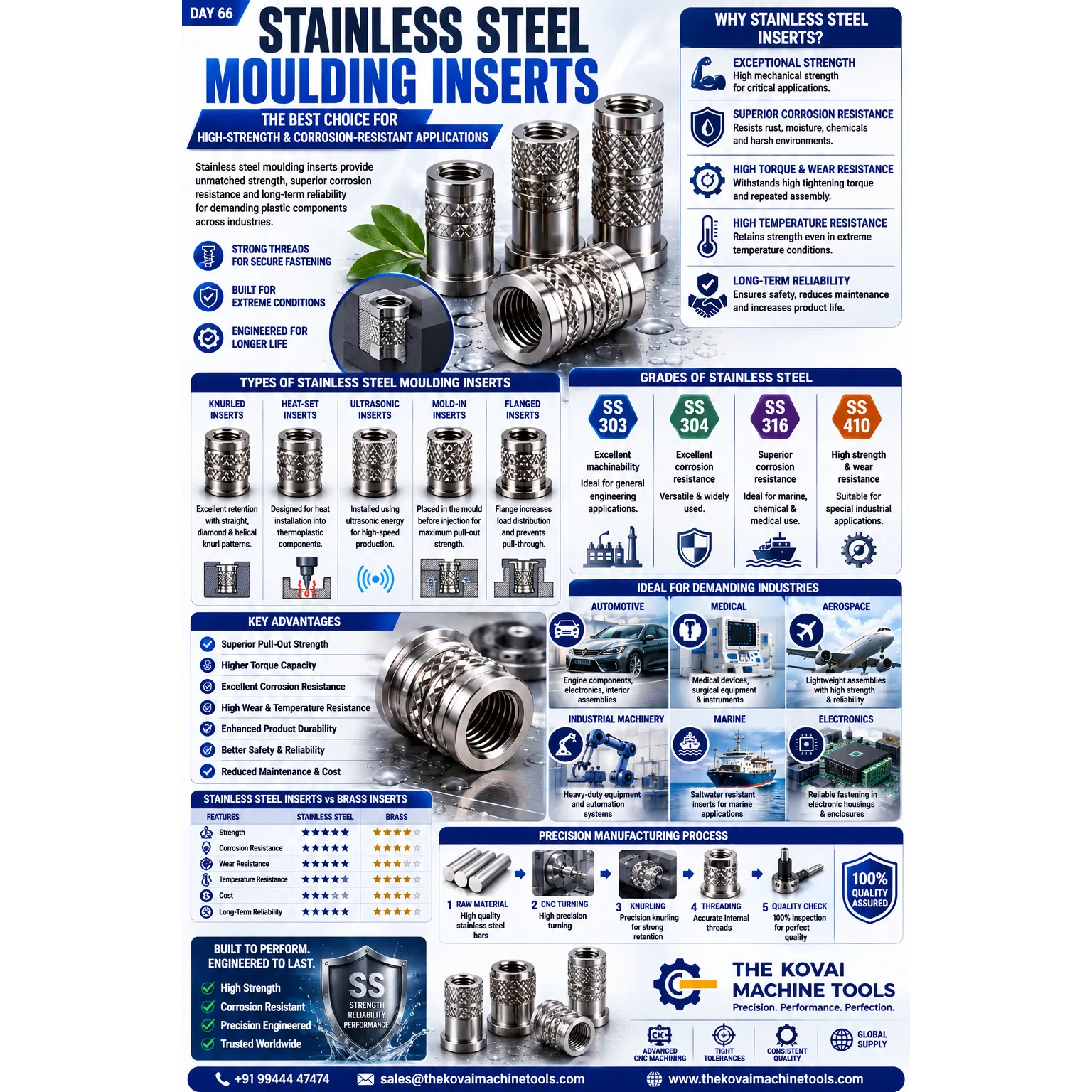
Common Grades of Stainless Steel Used
Different grades are selected based on application requirements.
SS 303
Provides excellent machinability.
Commonly used for general engineering applications.
SS 304
Offers excellent corrosion resistance and versatility.
Widely used across multiple industries.
SS 316
Provides superior corrosion resistance, especially in marine and chemical environments.
Often used in medical and offshore applications.
SS 410
Offers high strength and wear resistance.
Suitable for specialized industrial applications.
Types of Stainless Steel Moulding Inserts
Various insert designs are available depending on the installation method and application.
Knurled Stainless Steel Inserts
Feature external knurling for improved retention.
Common knurl patterns include:
- Straight knurl
- Diamond knurl
- Helical knurl
Heat-Set Stainless Steel Inserts
Installed using heat into thermoplastic components.
Provide excellent retention strength.
Ultrasonic Stainless Steel Inserts
Designed for installation using ultrasonic energy.
Ideal for automated high-volume production.
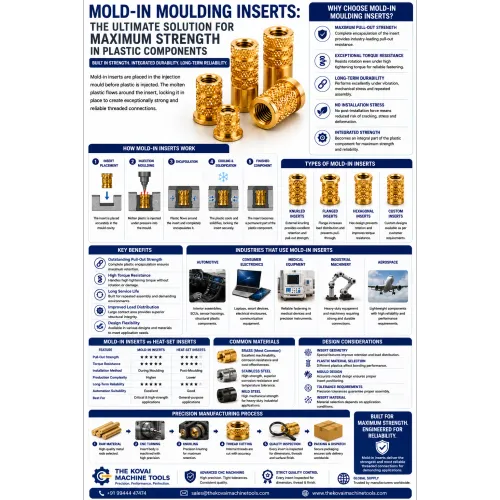
Mold-In Stainless Steel Inserts
Placed inside the mould before injection moulding.
Offer maximum pull-out strength.
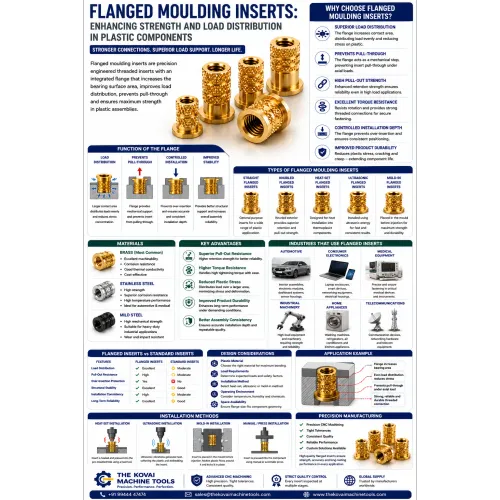
Flanged Stainless Steel Inserts
Feature an integrated flange for improved load distribution and positioning.
Advantages of Stainless Steel Moulding Inserts
Superior Pull-Out Strength
Stainless steel inserts provide strong mechanical retention within plastic components.
This ensures excellent resistance to axial forces.
Higher Torque Capacity
These inserts can withstand significantly higher tightening torque compared to plastic threads.
Benefits include:
- Stronger fastening
- Improved assembly reliability
- Reduced thread failure
Enhanced Product Durability
Stainless steel inserts significantly improve the lifespan of plastic assemblies.
Resistance to Harsh Environments
Ideal for applications exposed to:
- Chemicals
- Moisture
- Extreme temperatures
- Outdoor conditions
Improved Safety
In safety-critical applications, reliable fastening is essential.
Stainless steel inserts reduce the risk of fastening failure.
Industries Using Stainless Steel Moulding Inserts
Automotive Industry
Applications include:
- Engine compartment components
- Electronic control systems
- Structural plastic assemblies
Automotive manufacturers rely on stainless steel inserts for durability and reliability.
Medical Industry
Medical equipment requires:
- Corrosion resistance
- Sterilization compatibility
- Precision
Stainless steel inserts meet these stringent requirements.
Aerospace Industry
Aircraft systems demand:
- Lightweight assemblies
- High strength
- Long-term reliability
Stainless steel inserts support these requirements.
Industrial Machinery
Heavy-duty machinery often operates under severe conditions.
Stainless steel inserts ensure dependable fastening performance.
Marine Industry
Marine applications require exceptional resistance to saltwater corrosion.
SS 316 inserts are particularly suitable.
Stainless Steel Inserts vs Brass Inserts
FeatureStainless Steel InsertsBrass InsertsStrengthVery HighHighCorrosion ResistanceExcellentGoodWear ResistanceExcellentGoodMachinabilityModerateExcellentCostHigherLowerTemperature ResistanceExcellentModerate
Both materials offer excellent performance, but stainless steel is preferred for harsh environments and high-load applications.
Precision Manufacturing of Stainless Steel Inserts
Because stainless steel is harder than brass, precision manufacturing becomes even more critical.
Modern CNC machining processes ensure:
- Accurate dimensions
- Precise thread profiles
- Tight tolerances
- Consistent quality
Advanced manufacturing technologies allow the production of complex stainless steel insert designs while maintaining exceptional accuracy.
Importance of Choosing the Right Manufacturer
Poorly manufactured inserts can lead to:
- Weak retention
- Assembly problems
- Product failures
- Reduced reliability
Therefore, manufacturers should work with experienced suppliers specializing in precision moulding inserts.
A reliable supplier ensures:
- Consistent quality
- Material traceability
- Precision machining
- Strict quality control
Future Demand for Stainless Steel Moulding Inserts
The growing demand for:
- Electric vehicles
- Medical technologies
- Smart industrial equipment
- Aerospace systems
- Marine applications
Will continue driving the use of stainless steel moulding inserts worldwide.
Their exceptional durability and reliability make them indispensable for future engineering applications.
Conclusion
Stainless steel moulding inserts provide one of the strongest and most durable fastening solutions available for plastic components.
Their superior mechanical strength, excellent corrosion resistance, high wear resistance, and long-term reliability make them ideal for demanding industrial environments.
From automotive and aerospace applications to medical devices and marine equipment, stainless steel inserts continue to play a vital role in improving product performance and durability.
For manufacturers seeking maximum reliability and long service life, stainless steel moulding inserts remain an outstanding engineering choice.
Call to Action
Looking for high-quality stainless steel moulding inserts, precision threaded inserts, or custom CNC turned components?
The Kovai Machine Tools specializes in manufacturing precision stainless steel moulding inserts engineered for superior strength, corrosion resistance, and long-term performance.
With advanced CNC machining technology, strict quality standards, and decades of manufacturing expertise, we deliver precision components trusted by industries worldwide.
📞 Contact us today to discuss your stainless steel moulding insert requirements and receive a customized engineering solution tailored to your application.
The Kovai Machine Tools – Precision Moulding Inserts Engineered for Strength, Durability, and Global Industrial Excellence. 🚀
Keywords