Flanged Moulding Inserts: Enhancing Strength and Load Distribution in Plastic Components
Introduction
As industries continue to adopt lightweight and high-performance plastic components, the need for reliable fastening solutions has become increasingly important. Plastic parts are extensively used in automotive systems, consumer electronics, industrial machinery, medical devices, home appliances, and telecommunication equipment because of their lightweight nature, corrosion resistance, and design flexibility.
However, plastic components often face challenges when subjected to:
- High mechanical loads
- Repeated assembly and disassembly
- Vibration
- Tightening torque
- Long-term operational stress
Traditional plastic threads alone may not provide sufficient strength for such demanding applications.
This is where flanged moulding inserts play a vital role.
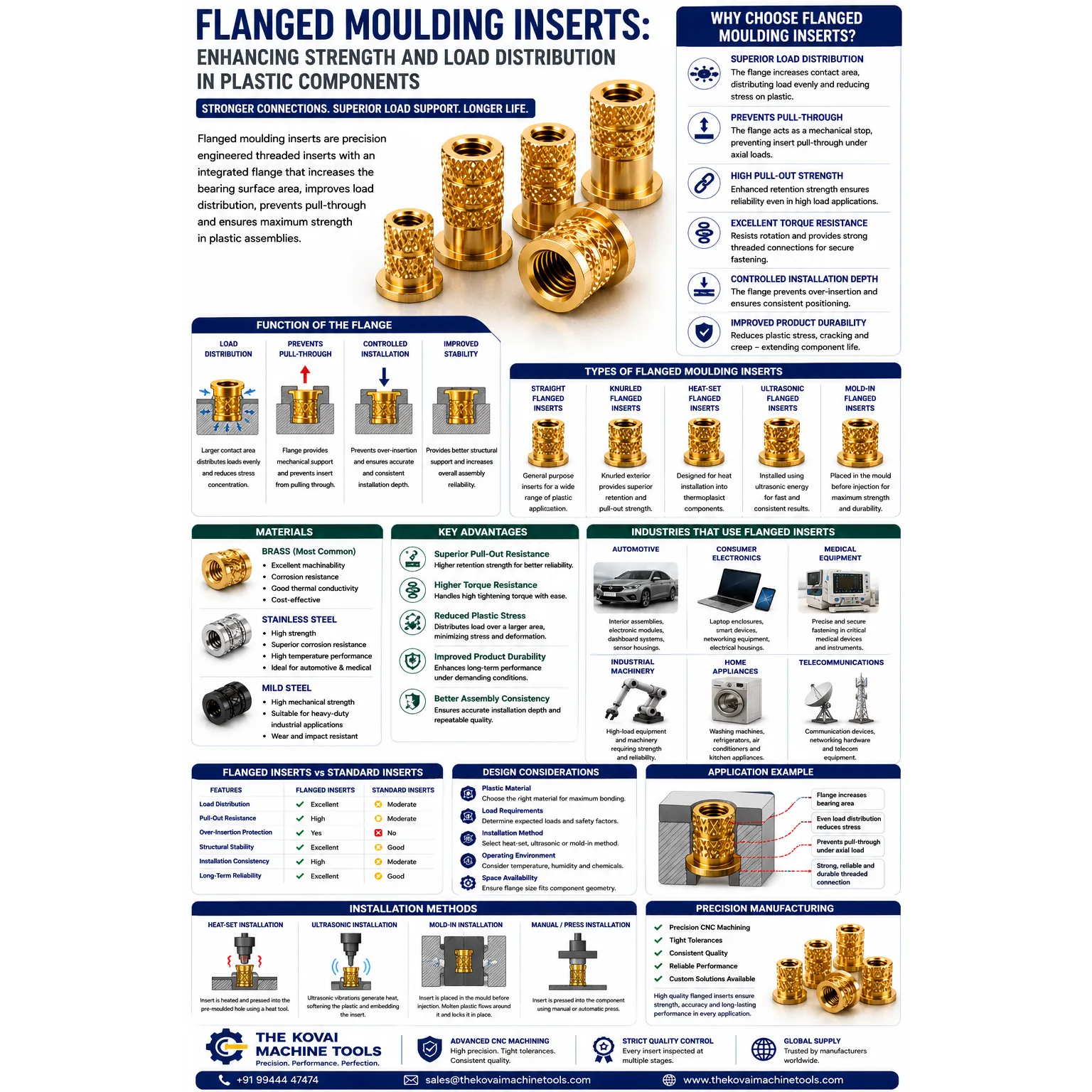
Flanged moulding inserts are specially designed threaded inserts that feature an integrated flange or collar. This flange significantly improves load distribution, prevents pull-through, and enhances the overall mechanical performance of plastic assemblies.
In this article, we will explore what flanged moulding inserts are, their design advantages, applications, benefits, and why industries worldwide rely on them for critical fastening applications.
What Are Flanged Moulding Inserts?
Flanged moulding inserts are precision-machined threaded inserts that include a flange at one end of the insert body.
The flange acts as an enlarged bearing surface that offers additional support within the plastic component.
Unlike standard inserts, flanged inserts provide:
- Improved load distribution
- Higher pull-out resistance
- Better positioning accuracy
- Prevention of insert over-insertion
- Enhanced assembly reliability
These characteristics make flanged inserts highly suitable for demanding engineering applications.
Understanding the Function of the Flange
The flange is one of the most important features of this insert design.
It performs multiple functions simultaneously.
1. Load Distribution
The flange increases the contact area between the insert and the plastic component.
This helps distribute mechanical loads more evenly.
As a result:
- Stress concentration is reduced.
- Plastic deformation is minimized.
- Component life is extended.
2. Prevention of Pull-Through
In applications subjected to axial loads, inserts may sometimes pull through the plastic component.
The flange acts as a mechanical stop that significantly reduces this risk.
3. Controlled Installation Depth
The flange prevents excessive insertion during assembly.
This ensures:
- Consistent positioning
- Improved dimensional accuracy
- Better assembly quality
4. Improved Structural Stability
The larger support area provided by the flange enhances the overall structural integrity of the assembly.
Types of Flanged Moulding Inserts
Different industries use various flanged insert designs depending on application requirements.
Straight Flanged Inserts
Feature a cylindrical body with a flange.
Suitable for general engineering applications.
Knurled Flanged Inserts
Include external knurling patterns for improved retention inside plastic components.
Common knurl types include:
- Straight knurl
- Diamond knurl
- Helical knurl
Heat-Set Flanged Inserts
Designed specifically for heat installation into thermoplastic components.
Provide excellent retention strength.
Ultrasonic Flanged Inserts
Installed using ultrasonic energy for high-volume production applications.
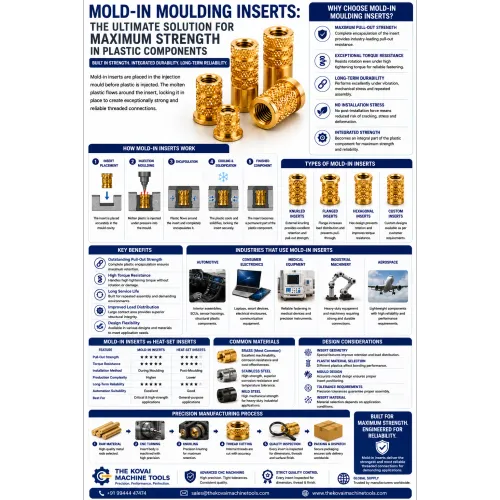
Mold-In Flanged Inserts
Placed inside the mould before injection moulding for maximum strength.
Materials Used for Flanged Inserts
Brass Flanged Inserts
Brass remains the most widely used material because of:
- Excellent machinability
- Corrosion resistance
- Good thermal conductivity
- Cost-effectiveness
Brass flanged inserts are commonly used across multiple industries.
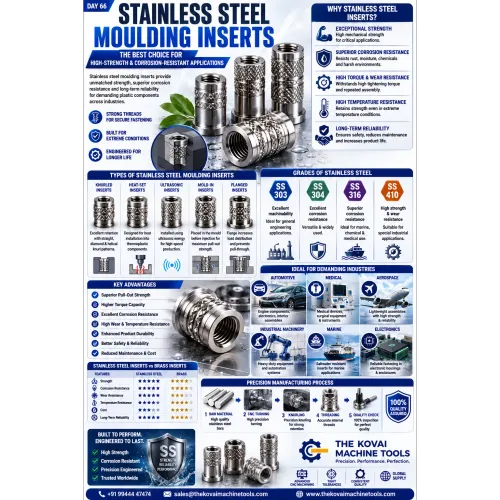
Stainless Steel Flanged Inserts
Used in applications requiring:
- High strength
- Superior corrosion resistance
- High-temperature performance
Ideal for automotive and medical applications.
Mild Steel Flanged Inserts
Suitable for heavy-duty industrial applications requiring maximum mechanical strength.
Key Advantages of Flanged Moulding Inserts
1. Superior Pull-Out Resistance
The flange increases retention strength by creating a larger contact surface within the plastic component.
This provides enhanced resistance against axial loads.
2. Higher Torque Resistance
Flanged inserts offer greater resistance to rotational forces.
Benefits include:
- Stronger threaded connections
- Reduced insert rotation
- Improved fastening reliability
3. Reduced Plastic Stress
By distributing loads over a larger area, the flange reduces localized stress within the plastic component.
This minimizes:
- Cracking
- Creep
- Material fatigue
4. Improved Product Durability
Flanged inserts improve the long-term reliability of plastic assemblies by preventing premature failure.
5. Better Assembly Consistency
The flange ensures accurate and repeatable installation depth.
This improves manufacturing consistency and quality control.
Industries That Use Flanged Moulding Inserts
Automotive Industry
Applications include:
- Interior assemblies
- Electronic modules
- Dashboard systems
- Sensor housings
Automotive manufacturers rely on flanged inserts for improved durability and vibration resistance.
Consumer Electronics
Used in:
- Laptop enclosures
- Smart devices
- Networking equipment
- Electrical housings
The compact design and reliability make them ideal for electronic products.
Medical Equipment
Medical devices require precise and secure fastening solutions.
Flanged inserts provide dependable performance in critical applications.
Industrial Machinery
Industrial equipment often experiences high loads and vibration.
Flanged inserts improve structural stability and service life.
Home Appliances
Commonly found in:
- Washing machines
- Refrigerators
- Air conditioners
- Kitchen appliances
Flanged Inserts vs Standard Inserts
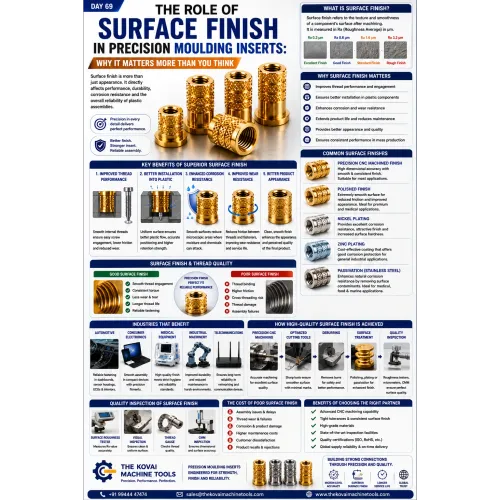
FeatureFlanged InsertsStandard InsertsLoad DistributionExcellentModeratePull-Out ResistanceHighModerateOver-Insertion ProtectionYesNoStructural StabilityExcellentGoodInstallation ConsistencyHighModerateLong-Term ReliabilityExcellentGood
The comparison clearly demonstrates why flanged inserts are preferred in high-performance applications.
Design Considerations for Flanged Inserts
Engineers should evaluate several factors when selecting flanged inserts.
Plastic Material
Different plastics exhibit varying mechanical properties.
Load Requirements
Expected mechanical loads determine insert size and flange dimensions.
Installation Method
The chosen installation process influences insert design.
Operating Environment
Factors such as temperature, humidity, and chemical exposure affect material selection.
Space Availability
Component geometry determines the maximum allowable flange size.
Importance of Precision Manufacturing
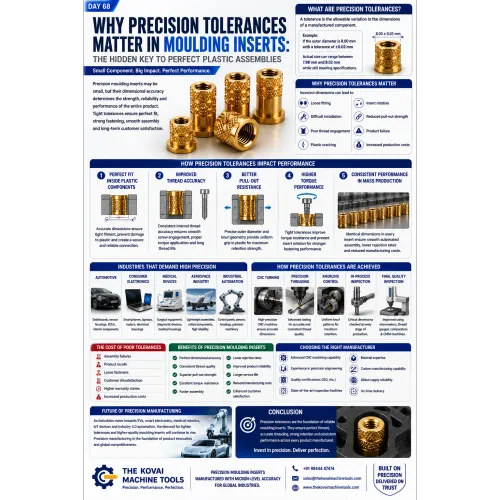
The performance of flanged moulding inserts depends heavily on manufacturing accuracy.
Precision manufacturing ensures:
- Accurate flange dimensions
- Tight tolerances
- Consistent thread quality
- Reliable installation
Modern CNC machining technologies allow manufacturers to produce highly accurate flanged inserts for demanding applications.
Poor-quality inserts may lead to:
- Misalignment
- Reduced retention strength
- Assembly failures
- Product reliability issues
Therefore, choosing a trusted precision component manufacturer is essential.
Future Demand for Flanged Moulding Inserts
As products become:
- More compact
- More lightweight
- More durable
- More performance-driven
The demand for flanged moulding inserts will continue to grow.
Industries increasingly require fastening solutions that provide superior load distribution and long-term reliability.
Flanged inserts will remain a key component in future engineering designs.
Conclusion
Flanged moulding inserts provide significant advantages over conventional threaded inserts by improving load distribution, increasing pull-out resistance, preventing over-insertion, and enhancing assembly reliability.
Their ability to strengthen plastic assemblies while extending product lifespan makes them indispensable across industries such as automotive, electronics, medical equipment, industrial machinery, and consumer appliances.
For manufacturers seeking stronger and more durable fastening solutions, flanged moulding inserts offer an excellent engineering solution.
Call to Action
Looking for high-quality flanged moulding inserts, brass inserts, or custom precision CNC turned components?
The Kovai Machine Tools specializes in manufacturing precision moulding inserts engineered for superior strength, reliability, and long-term performance.
With advanced CNC machining capabilities, stringent quality control, and decades of manufacturing expertise, we deliver precision components trusted by manufacturers worldwide.
📞 Contact us today to discuss your moulding insert requirements and receive a customized engineering solution tailored to your application.
The Kovai Machine Tools – Precision Moulding Inserts Engineered for Global Industrial Excellence. 🚀
Keywords