Mold-In Moulding Inserts: The Ultimate Solution for Maximum Strength in Plastic Components
Introduction
As industries continue to move toward lightweight, high-performance products, plastic components have become essential in modern manufacturing. From automotive systems and consumer electronics to medical devices and industrial equipment, plastic parts offer numerous advantages such as reduced weight, corrosion resistance, design flexibility, and cost-effective production.
However, when plastic components require strong threaded connections capable of withstanding heavy loads, vibration, repeated assembly, and long-term use, plastic alone often falls short.
This is where mold-in moulding inserts provide an exceptional solution.
Mold-in inserts are among the strongest and most reliable fastening solutions available for plastic components. Unlike post-installed inserts, mold-in inserts are placed directly into the mould before the injection moulding process begins. As the molten plastic flows around the insert during moulding, it creates an extremely strong bond between the insert and the plastic part.
Because of their superior retention strength and durability, mold-in inserts are widely used in critical applications where fastening reliability is essential.
In this article, we will explore what mold-in moulding inserts are, how they work, their advantages, applications, and why they are preferred for high-strength plastic assemblies.
What Are Mold-In Moulding Inserts?
Mold-in moulding inserts are precision-machined metal components that are positioned inside an injection mould before plastic material is injected.
During the moulding cycle:
- The insert is placed inside the mould cavity.
- Molten plastic is injected into the mould.
- The plastic completely encapsulates the insert.
- After cooling, the insert becomes permanently integrated into the plastic component.
This process creates an exceptionally strong mechanical bond that offers outstanding retention and durability.
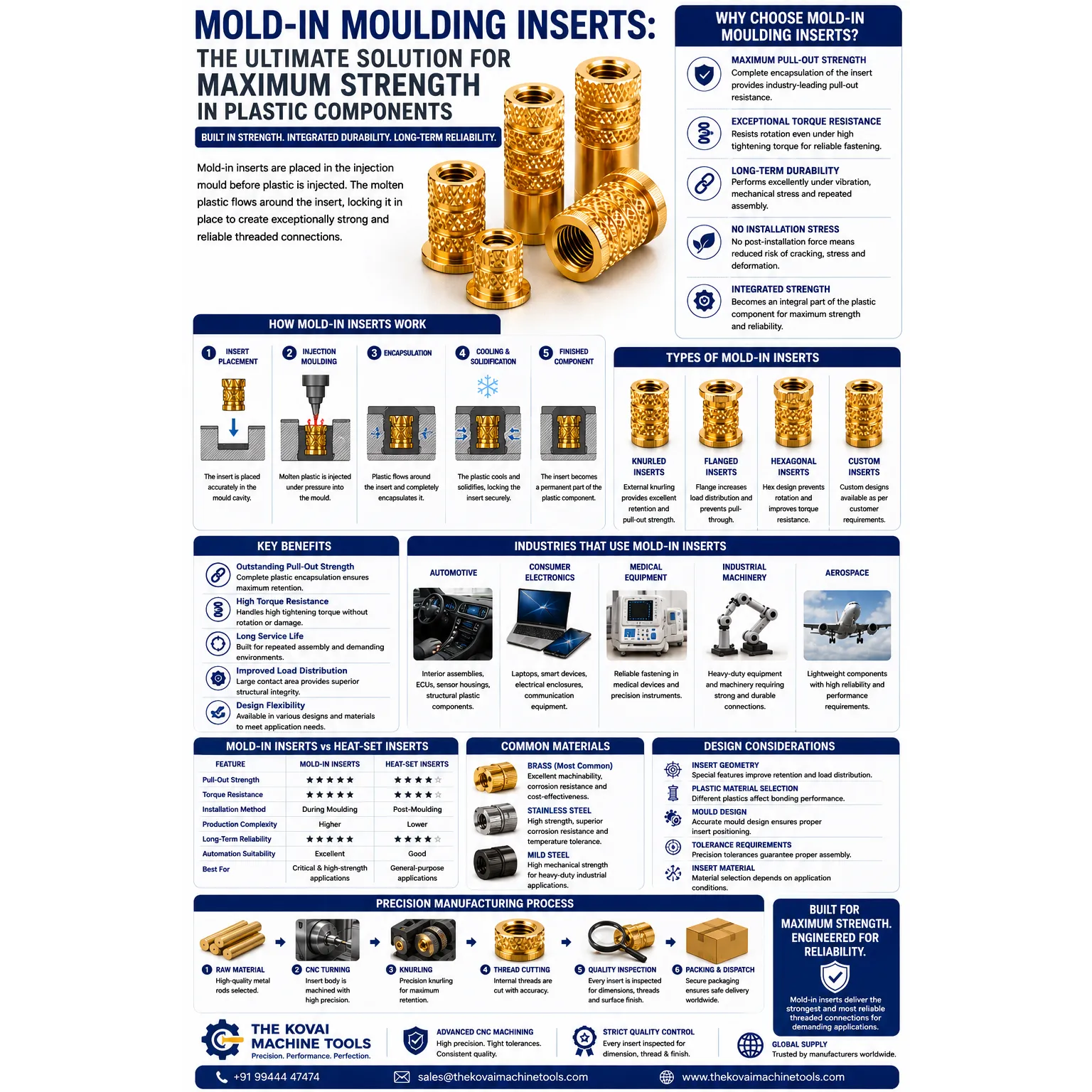
How Mold-In Inserts Work
The mold-in process involves several carefully controlled steps.
Step 1: Insert Placement
The precision insert is positioned accurately within the mould cavity before injection.
Proper positioning ensures precise alignment in the finished component.
Step 2: Injection Moulding
Molten plastic is injected under pressure into the mould.
The plastic flows around the insert and fills all surrounding spaces.
Step 3: Encapsulation
As the plastic fills the mould, it fully surrounds the knurled or specially designed insert surface.
This creates maximum surface contact.
Step 4: Cooling and Solidification
The plastic cools and solidifies around the insert.
The insert becomes permanently locked inside the component.
Step 5: Finished Component
The final plastic part contains a fully integrated metal insert capable of providing strong and reliable threaded connections.
Why Mold-In Inserts Provide Superior Strength
Mold-in inserts are often considered the strongest insert installation method.
Several factors contribute to their exceptional performance.
1. Complete Plastic Encapsulation
Because the insert is embedded during moulding, the plastic completely surrounds the insert geometry.
This provides:
- Maximum contact area
- Excellent load distribution
- Superior retention
The result is significantly higher pull-out resistance compared to post-installed inserts.
2. Outstanding Pull-Out Strength
Pull-out strength is critical in applications subjected to high loads.
Mold-in inserts offer industry-leading pull-out resistance because the insert becomes an integral part of the plastic structure.
This makes them ideal for:
- Structural assemblies
- Heavy-duty applications
- Safety-critical components
3. Exceptional Torque Resistance
Mold-in inserts resist rotational forces extremely well.
The complete encapsulation prevents insert rotation even under high tightening torque.
Benefits include:
- Stronger fastening
- Improved assembly reliability
- Reduced maintenance issues
4. Long-Term Durability
Since the insert is permanently integrated into the component, long-term reliability is greatly improved.
Mold-in inserts perform exceptionally well under:
- Continuous vibration
- Mechanical stress
- Repeated assembly
- Harsh environmental conditions
5. Reduced Risk of Plastic Damage
Unlike force-based installation methods, mold-in inserts do not introduce installation stresses after moulding.
This minimizes:
- Cracking
- Stress concentration
- Plastic deformation
As a result, component integrity remains high.
Common Materials Used for Mold-In Inserts
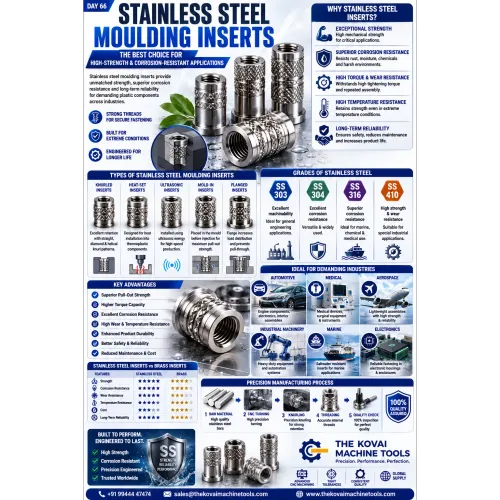
Brass Mold-In Inserts
Brass is widely preferred because of:
- Excellent machinability
- Corrosion resistance
- Cost-effectiveness
- High precision
Brass inserts are commonly used in electronics and consumer products.
Stainless Steel Mold-In Inserts
Ideal for demanding applications requiring:
- High strength
- Corrosion resistance
- Temperature resistance
Common in automotive and medical sectors.
Mild Steel Mold-In Inserts
Used for heavy-duty industrial applications where maximum strength is required.
Types of Mold-In Inserts
Different insert designs are used depending on application requirements.
Knurled Mold-In Inserts
Feature external knurling for enhanced retention.
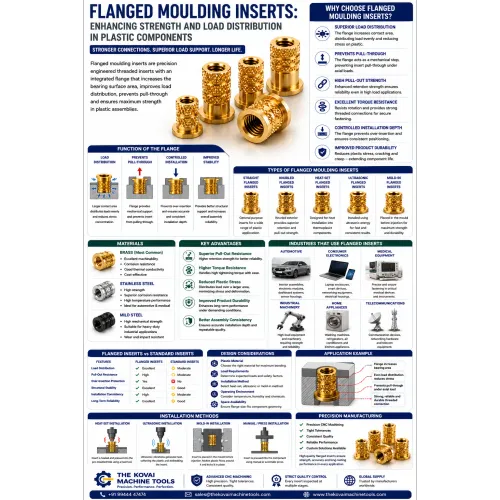
Flanged Mold-In Inserts
Include a flange to improve load distribution and prevent pull-through.
Hexagonal Inserts
Designed to prevent rotation within the plastic component.
Custom Mold-In Inserts
Manufactured according to customer specifications for specialized applications.
Industries That Use Mold-In Moulding Inserts
Automotive Industry
Applications include:
- Interior assemblies
- Structural plastic components
- Sensor housings
- Electronic modules
Automotive manufacturers depend on mold-in inserts for long-term reliability.
Consumer Electronics
Used in:
- Laptop housings
- Smart devices
- Electrical enclosures
- Communication equipment
Medical Equipment
Medical devices require secure and reliable fastening.
Mold-in inserts provide exceptional durability and precision.
Industrial Machinery
Heavy-duty equipment often operates under demanding conditions.
Mold-in inserts ensure dependable fastening performance.
Aerospace Components
Weight reduction and reliability are critical in aerospace applications.
Mold-in inserts support both requirements effectively.
Mold-In Inserts vs Heat-Set Inserts
FeatureMold-In InsertsHeat-Set InsertsPull-Out StrengthExcellentVery GoodTorque ResistanceExcellentVery GoodInstallation MethodDuring MouldingPost-MouldingProduction ComplexityHigherLowerLong-Term ReliabilityExcellentVery GoodAutomation SuitabilityExcellentGood
Both solutions are highly effective, but mold-in inserts offer superior retention for critical applications.
Design Considerations for Mold-In Inserts
To maximize performance, engineers should consider:
Insert Geometry
Special features improve retention and load distribution.
Plastic Material Selection
Different plastics affect bonding performance.
Mould Design
Accurate mould design ensures proper insert positioning.
Tolerance Requirements
Precision tolerances guarantee proper assembly.
Insert Material
Material selection depends on application conditions.
Importance of Precision Manufacturing
Because mold-in inserts become a permanent part of the product, manufacturing precision is essential.
High-quality inserts require:
- Tight dimensional tolerances
- Precise threads
- Accurate knurling
- Consistent quality
Advanced CNC machining ensures reliable performance and repeatability.
Poor-quality inserts can lead to:
- Misalignment
- Weak retention
- Product failures
- Increased manufacturing costs
This makes supplier selection extremely important.
Future Demand for Mold-In Inserts
As industries continue developing:
- Lightweight vehicles
- Smart electronic products
- Advanced medical devices
- High-performance industrial equipment
The demand for mold-in inserts will continue to rise.
Manufacturers increasingly prefer solutions that provide maximum strength, reliability, and long service life.
Conclusion
Mold-in moulding inserts represent one of the strongest and most reliable fastening solutions available for plastic components.
Their exceptional pull-out resistance, superior torque performance, long-term durability, and excellent structural integration make them ideal for demanding applications across multiple industries.
For manufacturers seeking maximum fastening strength and long-term product reliability, mold-in inserts remain an outstanding engineering solution.
Call to Action
Looking for high-quality mold-in moulding inserts, brass inserts, or custom precision CNC turned components?
The Kovai Machine Tools specializes in manufacturing precision moulding inserts engineered for superior strength, accuracy, and long-term performance.
With advanced CNC machining technology, stringent quality standards, and extensive industry expertise, we deliver precision components trusted by manufacturers worldwide.
📞 Contact us today to discuss your moulding insert requirements and receive a customized engineering solution for your application.
The Kovai Machine Tools – Precision Moulding Inserts Designed for Maximum Strength and Reliability. 🚀
Keywords