
Why Aluminum Inserts Are Becoming Popular in Modern Manufacturing
Introduction
Modern industries are constantly searching for components that are:
- Lightweight
- Durable
- Corrosion resistant
- Cost-effective
One component that is gaining significant importance across industries is the aluminum insert.
Aluminum inserts are widely used in applications where manufacturers require a balance between strength and reduced weight. Industries such as automotive, aerospace, electronics, and industrial equipment increasingly rely on aluminum inserts for high-performance assemblies.
In this blog, we will explore:
- What aluminum inserts are
- Their advantages
- Industrial applications
- Why they are becoming a preferred fastening solution worldwide
What Are Aluminum Inserts?
Aluminum inserts are precision-machined threaded components used to provide strong fastening points inside softer materials such as:
- Plastic
- Aluminum housings
- Composite materials
These inserts improve thread life, assembly strength, and durability.
Why Aluminum Inserts Are Important
1. Lightweight Performance
One of the biggest advantages of aluminum is its low weight.
👉 Aluminum inserts help:
- Reduce overall product weight
- Improve fuel efficiency in vehicles
- Support lightweight product design
This is especially important in:
- Automotive industry
- Aerospace applications
- Portable electronics
2. Excellent Corrosion Resistance
Aluminum naturally forms a protective oxide layer.
👉 Benefits include:
- Rust resistance
- Longer component life
- Better environmental durability
Ideal for humid and outdoor applications.
3. Good Strength-to-Weight Ratio
Although lightweight, aluminum offers excellent mechanical strength.
👉 This allows:
- Reliable fastening
- Stable performance
- Structural durability
4. High Precision Machining
Aluminum is easy to machine with precision.
Manufacturers can produce:
- Accurate threads
- Fine surface finish
- Tight dimensional tolerances
5. Thermal and Electrical Conductivity
Aluminum inserts are suitable for applications requiring:
- Heat dissipation
- Electrical conductivity
This makes them highly useful in electronics and electrical industries.
Types of Aluminum Inserts
Threaded Inserts
Used for strong internal threading applications.
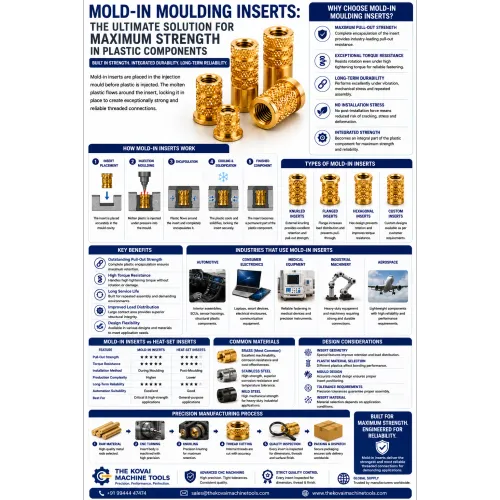
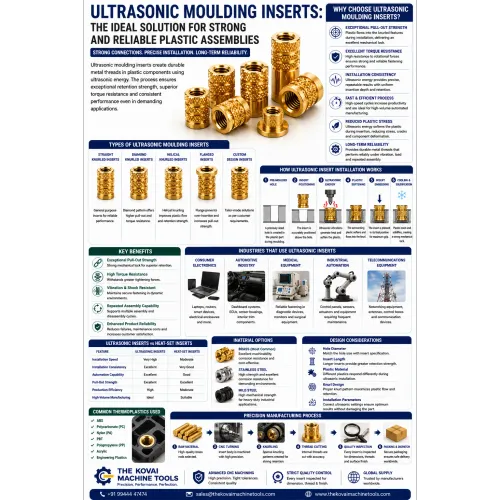
Knurled Inserts
Provide better grip and anti-rotation performance.
Heat Set Inserts
Installed into plastic components using heat.
Custom CNC Inserts
Manufactured according to specific industrial requirements.
Industries Using Aluminum Inserts
Automotive Industry
Used in:
- Lightweight assemblies
- Interior plastic components
- EV applications
Electronics Industry
Used in:
- Electronic housings
- Heat management systems
- Electrical enclosures
Aerospace Industry
Preferred due to:
- Weight reduction
- Corrosion resistance
- Structural reliability
Industrial Equipment
Used in:
- Precision machinery
- Lightweight mechanical assemblies
Benefits for Manufacturers
Using aluminum inserts helps manufacturers achieve:
- Reduced product weight
- Faster machining
- Better production efficiency
- Lower transportation costs
Benefits for End Customers
Customers benefit from:
- Lightweight products
- Improved durability
- Corrosion resistance
- Better product performance
Importance of Precision Manufacturing
High-quality aluminum inserts require:
- CNC precision machining
- Accurate threading
- Controlled surface finishing
- Strict inspection processes
Precision ensures:
- Perfect fitting
- Reliable fastening
- Long-term performance
Common Problems with Low-Quality Inserts
Poorly manufactured inserts can lead to:
- Loose fitting
- Weak threads
- Poor grip strength
- Premature failure
This is why selecting a reliable manufacturer is critical.
Future Demand for Aluminum Inserts
The demand for aluminum inserts is increasing due to:
- Electric vehicles (EVs)
- Lightweight engineering
- Smart electronics
- Sustainable manufacturing
As industries focus on reducing weight while maintaining performance, aluminum inserts will continue to play a major role.
Conclusion
Aluminum inserts are becoming an essential fastening solution in modern manufacturing because they combine:
✔ Lightweight design
✔ Precision performance
✔ Corrosion resistance
✔ Reliable fastening strength
Their growing use across industries proves their importance in future-ready engineering applications.
Keywords