
CNC Machining Ensures High Accuracy in Moulding Inserts
Introduction
In modern manufacturing industries, precision is no longer optional — it is a necessity. Industries such as automotive, electronics, medical equipment, aerospace, and industrial machinery require components that meet extremely tight tolerances and perform reliably under demanding conditions.
One such critical component is the moulding insert.
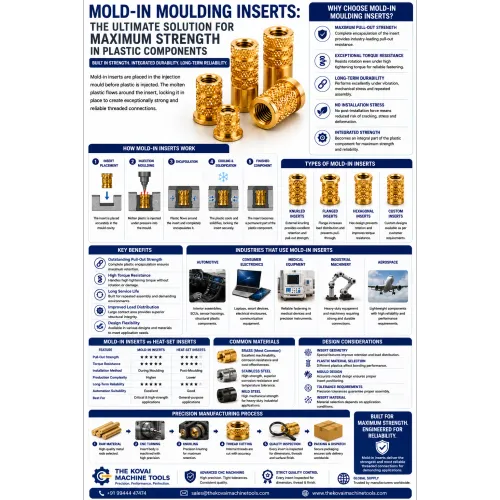
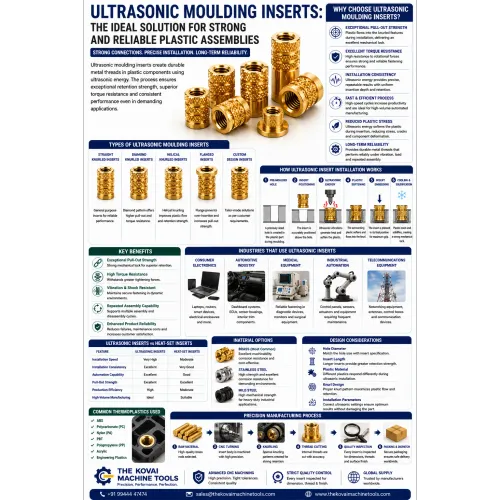
Moulding inserts are precision-engineered metal components embedded into plastic parts to provide durable threads, improve mechanical strength, and enhance the overall reliability of the product.
However, the performance of moulding inserts depends greatly on one key factor:
Manufacturing Accuracy
Even a small dimensional variation in a moulding insert can lead to:
- Improper fitting
- Weak thread engagement
- Assembly failure
- Plastic component damage
- Reduced product lifespan
This is why manufacturers rely on CNC machining to produce high-precision moulding inserts with consistent quality.
In this article, we will explore how CNC machining ensures high accuracy in moulding inserts, why precision is critical, and how it benefits industries worldwide.
What Is CNC Machining?
CNC stands for Computer Numerical Control.
CNC machining is an advanced manufacturing process in which computer-controlled machines precisely cut, shape, and finish metal components according to programmed specifications.
Unlike manual machining, CNC machines operate with extremely high precision and repeatability.
This technology is widely used to manufacture:
- Precision moulding inserts
- CNC turned components
- Bushes
- Shafts
- Rivets
- Fasteners
- Industrial precision parts
Because moulding inserts require highly accurate dimensions and thread profiles, CNC machining is the preferred manufacturing method.
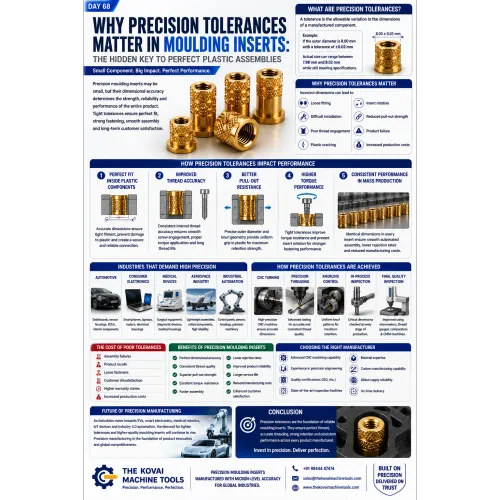
Why Accuracy Matters in Moulding Inserts
Moulding inserts are small components, but they perform a highly critical function inside plastic products.
Their accuracy directly affects:
- Product strength
- Assembly performance
- Fastener reliability
- Thread engagement
- Plastic component durability
A poorly manufactured insert can create several problems.
Problems Caused by Inaccurate Inserts
Loose Fitting
If the insert dimensions are smaller than required, it may become loose inside the plastic component.
This reduces fastening strength.
Plastic Cracking
If the insert is oversized, excessive pressure during installation can crack the surrounding plastic material.
Poor Thread Engagement
Incorrect thread profiles can lead to:
- Cross-threading
- Fastener misalignment
- Weak screw engagement
Reduced Product Life
Inaccurate inserts may fail under repeated use or mechanical stress.
This affects the reliability and lifespan of the final product.
How CNC Machining Improves Accuracy
CNC machining solves these challenges by ensuring precise manufacturing at every stage.
1. Tight Dimensional Tolerances
CNC machines are capable of producing components with extremely tight tolerances.
This ensures that every moulding insert matches the exact dimensions specified in the design.
Benefits
- Perfect fit inside plastic components
- Consistent assembly quality
- Reduced production defects
This level of precision is difficult to achieve with conventional machining methods.
2. Accurate Thread Cutting
Thread quality is one of the most critical features of a moulding insert.
CNC machining allows manufacturers to produce:
- Accurate internal threads
- Consistent pitch and depth
- Smooth thread profiles
Why This Matters
Precise threads ensure:
- Smooth screw engagement
- Strong fastening
- Reduced thread wear
This improves both assembly efficiency and long-term durability.
3. Consistency in Mass Production
Modern industries often require thousands or millions of identical inserts.
CNC machining ensures that every insert produced maintains the same dimensions and quality.
Advantages
- Reliable large-scale production
- Reduced rejection rates
- Stable manufacturing processes
Consistency is especially important in industries such as automotive and electronics.
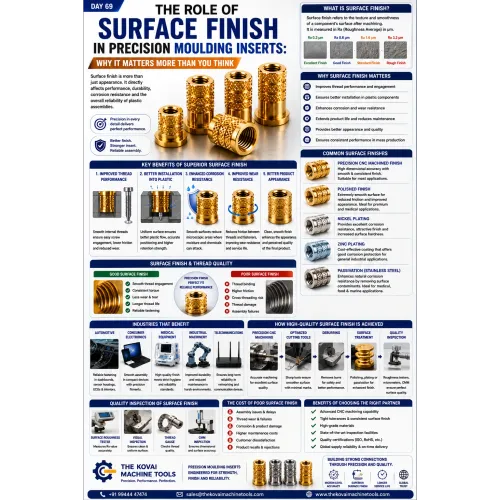
4. Superior Surface Finish
CNC machining produces moulding inserts with smooth and accurate surface finishes.
This improves:
- Insert installation
- Thread engagement
- Corrosion resistance
- Product appearance
A high-quality surface finish also helps reduce friction during assembly.
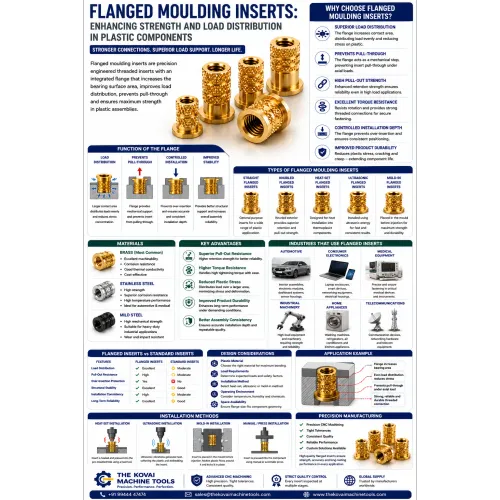
5. Precision Knurling and Retention Features
Many moulding inserts include external features such as:
- Knurling
- Grooves
- Serrations
These features help the insert grip the plastic securely.
CNC machining ensures these retention features are manufactured with high precision for strong bonding with plastic components.
6. Reduced Human Error
Traditional machining methods depend heavily on operator skill.
CNC machining uses computer-controlled programming, reducing the chances of human error.
Benefits
- Higher accuracy
- Better repeatability
- Consistent product quality
This improves manufacturing reliability and efficiency.
Materials Commonly Machined Using CNC Technology
CNC machining can produce moulding inserts from various engineering materials.
Brass Inserts
Brass is widely used because of its excellent machinability and corrosion resistance.
Brass inserts are commonly used in:
- Electronics
- Appliance manufacturing
- Consumer products
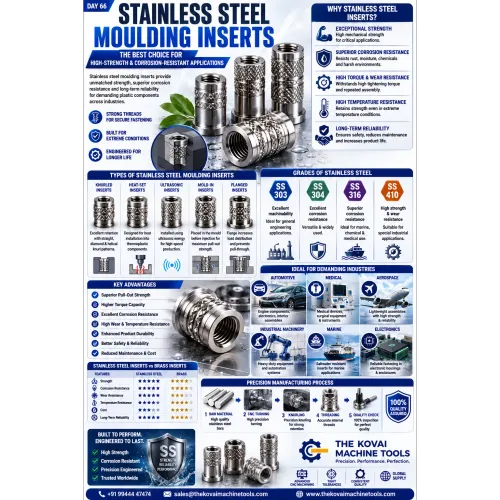
Stainless Steel Inserts
Stainless steel provides high strength and excellent resistance to corrosion.
These inserts are used in:
- Automotive applications
- Industrial machinery
- Medical equipment
Mild Steel Inserts
Mild steel inserts are used in heavy-duty applications requiring strong mechanical performance.
Aluminium Inserts
Aluminium inserts are ideal for lightweight applications where reducing product weight is important.
Industries That Depend on CNC Machined Moulding Inserts
Many industries rely on CNC-machined moulding inserts for reliable product performance.
Automotive Industry
Vehicles use plastic components in dashboards, control systems, sensors, and interior assemblies.
Precision inserts ensure strong fastening and vibration resistance.
Consumer Electronics
Electronic devices require accurate threaded connections for assembly and maintenance.
CNC-machined inserts provide reliable fastening in plastic housings.
Industrial Machinery
Machinery manufacturers use inserts in equipment that must withstand mechanical stress and repeated use.
Medical Equipment
Medical devices require highly precise and reliable components.
CNC machining ensures inserts meet strict quality standards.
Importance of Quality Control in CNC Machining
Precision manufacturing also requires strict quality inspection.
High-quality moulding inserts undergo testing for:
- Dimensional accuracy
- Thread quality
- Surface finish
- Material consistency
Advanced inspection equipment helps manufacturers maintain high standards and ensure product reliability.
Benefits of CNC Machined Moulding Inserts
Using CNC machining for moulding inserts provides several important advantages.
High Precision
Ensures accurate dimensions and thread profiles.
Excellent Repeatability
Every component maintains consistent quality.
Improved Product Reliability
Strong and accurate inserts improve the performance of plastic components.
Better Assembly Efficiency
Precise threads allow smooth and reliable fastening.
Longer Product Life
High-quality inserts resist wear and mechanical stress.
The Future of Precision Manufacturing
As industries continue to demand lighter, stronger, and more reliable products, precision manufacturing will become even more important.
Advanced CNC technologies, automation, and high-speed machining will continue to improve the accuracy and efficiency of moulding insert production.
Manufacturers that invest in precision machining will be better equipped to meet the growing demands of global industries.
Conclusion
Moulding inserts may be small components, but their accuracy plays a major role in the strength, durability, and reliability of plastic products.
CNC machining ensures that moulding inserts are manufactured with:
- Tight tolerances
- Accurate thread profiles
- Consistent dimensions
- High-quality surface finishes
This level of precision improves assembly performance, reduces defects, and increases product lifespan.
As a result, CNC machining has become the preferred manufacturing process for producing high-quality moulding inserts used across industries worldwide.