
CNC Turned Components in Modern Manufacturing – Why Precision Matters
Introduction
Modern industries demand products that are stronger, more reliable, and manufactured with extreme accuracy. From automotive systems and industrial machinery to electronics and medical devices, precision components are the backbone of today’s manufacturing world.
One of the most important manufacturing processes used to create these high-accuracy parts is CNC turning.
CNC turned components are widely used because they offer exceptional precision, consistency, and durability. These components are manufactured using advanced CNC turning machines that produce highly accurate parts with tight tolerances and superior surface finishes.
Industries across the world rely on CNC turned components for applications where even the smallest dimensional variation can affect product performance.
In this article, we will explore:
- What CNC turned components are
- Why precision matters in manufacturing
- Industries that depend on CNC machining
- Benefits of CNC turned parts
- How precision manufacturing improves product quality
If you are searching for reliable precision components for industrial applications, understanding the importance of CNC turned components is essential.
What Are CNC Turned Components?
CNC turned components are precision-engineered parts manufactured using Computer Numerical Control (CNC) turning machines.
In the turning process:
- A metal rod or bar rotates at high speed
- Cutting tools remove material with extreme accuracy
- The final component is produced according to exact dimensions
CNC turning is commonly used to manufacture components such as:
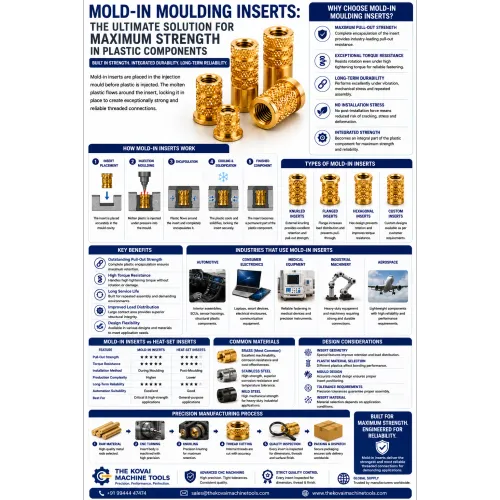
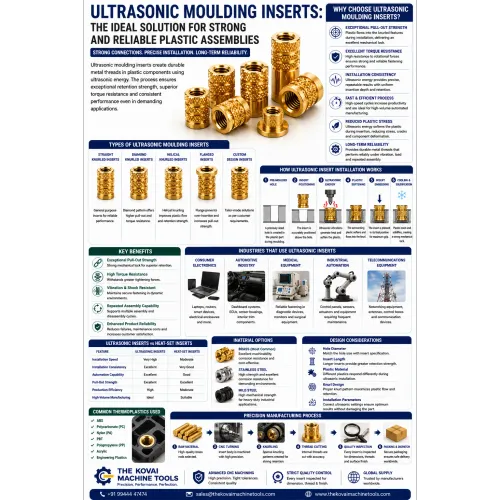
- Moulding inserts
- Bushes
- Shafts
- Pins
- Fasteners
- Connectors
- Threaded inserts
- Precision spacers
Because CNC machines are computer-controlled, they can repeatedly manufacture components with very high consistency.
Why Precision Matters in CNC Manufacturing
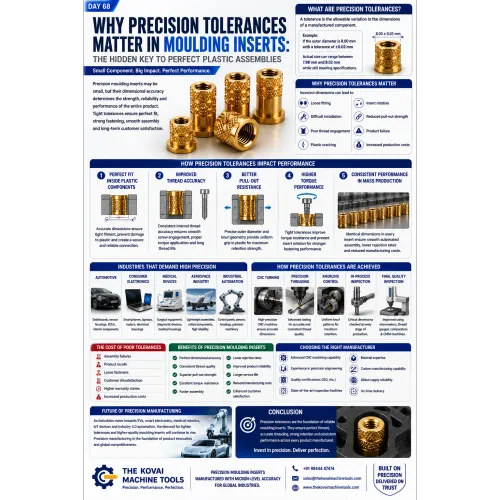
Precision is one of the most important factors in modern manufacturing.
Even a small error in dimensions can cause:
- Poor fitting between components
- Product malfunction
- Assembly issues
- Reduced durability
- Increased maintenance costs
Precision manufacturing ensures that every component meets exact engineering specifications.
1. Accurate Dimensions Ensure Perfect Fit
Many industrial products contain multiple assembled parts.
If one component is slightly oversized or undersized, it can affect the performance of the entire assembly.
Precision CNC turning ensures:
- Exact dimensions
- Tight tolerances
- Consistent fitting
This improves assembly quality and product reliability.
2. Improved Product Performance
Precision components help machines and products operate smoothly.
Accurate machining reduces:
- Friction
- Misalignment
- Vibration
- Wear and tear
This improves the overall performance and efficiency of the product.
3. Better Durability and Long Product Life
Poorly manufactured components may wear out quickly or fail under stress.
Precision CNC turned components provide:
- Strong structural integrity
- Smooth surfaces
- Consistent mechanical properties
This increases the lifespan of industrial products and machinery.
4. Reliable Mass Production
Industries often require thousands or millions of identical components.
CNC turning ensures every component is manufactured with the same accuracy and quality.
This consistency is critical for large-scale production.
Common Materials Used in CNC Turned Components
Different materials are used depending on the application requirements.
Brass Components
Brass is widely used because of its:
- Excellent machinability
- Corrosion resistance
- Smooth finishing
Brass CNC components are commonly used in electrical, electronics, and moulding insert applications.
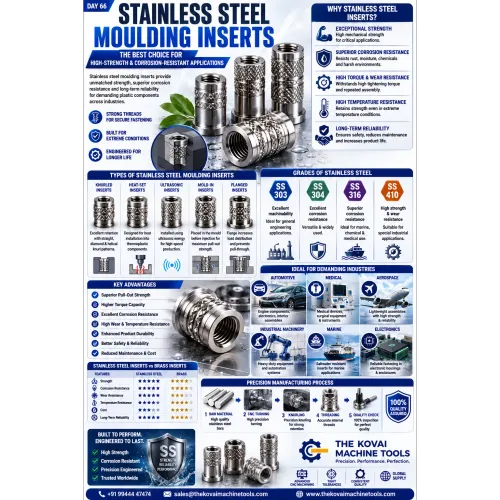
Stainless Steel Components
Stainless steel offers:
- High strength
- Corrosion resistance
- Temperature resistance
These components are used in automotive, medical, and industrial applications.
Mild Steel Components
Mild steel is used for heavy-duty applications requiring strength and durability.
Aluminium Components
Aluminium components are lightweight and corrosion-resistant, making them suitable for aerospace and electronics applications.
Industries That Depend on CNC Turned Components
CNC machining plays a major role in multiple industries.
Automotive Industry
Automotive manufacturers use CNC turned components in:
- Engine assemblies
- Sensor housings
- Fastening systems
- Plastic moulding inserts
Precision is critical in automotive applications because components must withstand vibration and mechanical stress.
Electronics Industry
Electronic products require highly accurate small components for reliable assembly.
CNC turned parts are widely used in:
- Connectors
- Electronic housings
- Precision inserts
- Terminals
Industrial Machinery
Industrial equipment relies on precision components for smooth mechanical operation.
CNC turned parts improve:
- Machine efficiency
- Reliability
- Operational accuracy
Medical Equipment
Medical devices require extremely precise components to ensure safety and performance.
Stainless steel CNC turned parts are widely used in medical instruments and equipment.
Role of CNC Turning in Moulding Insert Manufacturing
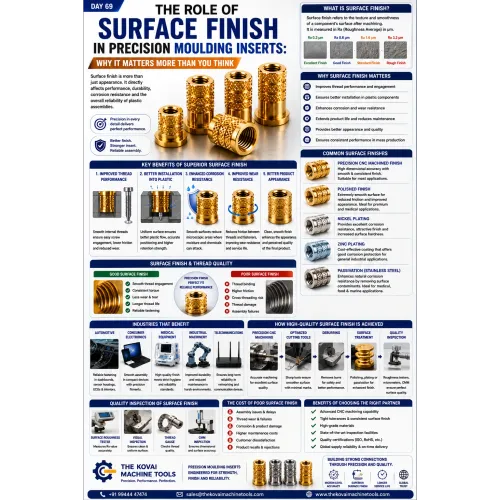
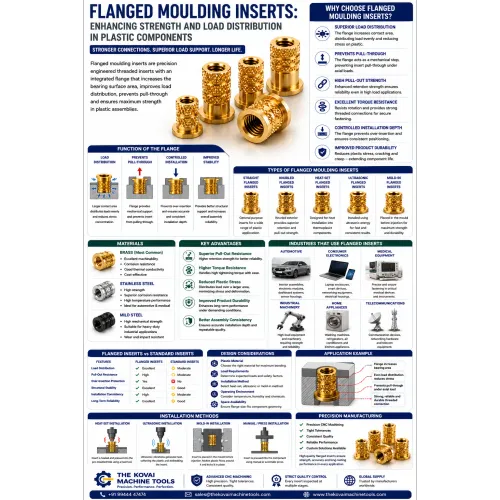
One of the most important applications of CNC turning is the manufacturing of precision moulding inserts.
Moulding inserts require:
- Accurate thread profiles
- Tight tolerances
- Smooth surfaces
- Consistent dimensions
CNC turning allows manufacturers to produce inserts that fit perfectly inside plastic components and provide reliable threaded fastening.
This is essential for industries such as:
- Automotive
- Consumer electronics
- Appliances
- Industrial products
Advantages of CNC Turned Components
High Accuracy
CNC machines produce components with exceptional dimensional precision.
Excellent Surface Finish
Precision machining creates smooth surfaces that improve product performance and appearance.
Faster Production
Modern CNC machines can produce large volumes of components efficiently.
Reduced Human Error
Computer-controlled machining minimizes manual errors and improves consistency.
Flexibility in Design
CNC turning allows manufacturers to produce complex component designs with high precision.
Importance of Choosing the Right CNC Manufacturing Partner
The quality of CNC turned components depends heavily on the expertise and manufacturing capabilities of the supplier.
A reliable manufacturer should provide:
- Advanced CNC machines
- Skilled engineering support
- Strict quality control
- High-quality raw materials
- Consistent production standards
Choosing an experienced precision machining company ensures better product quality and long-term reliability.
Future of CNC Precision Manufacturing
As industries continue to demand:
- Higher performance
- Smaller tolerances
- Lightweight products
- Advanced automation
the importance of CNC precision manufacturing will continue to grow.
Modern CNC technology is evolving rapidly with:
- Multi-axis machining
- Automation systems
- Smart manufacturing
- Advanced inspection technologies
This will further improve manufacturing accuracy and production efficiency.
Conclusion
CNC turned components are essential in modern manufacturing because they provide the precision, durability, and consistency required for high-performance industrial applications.
From moulding inserts and automotive parts to industrial machinery and electronics, precision CNC machining plays a critical role in ensuring reliable product performance.
By using advanced CNC turning processes and high-quality materials, manufacturers can produce components that meet the demanding requirements of modern industries.
As precision engineering continues to evolve, CNC turned components will remain a key part of global manufacturing.
Keywords