
Custom Moulding Inserts vs Standard Inserts: Which Is Right for Your Application?
Introduction
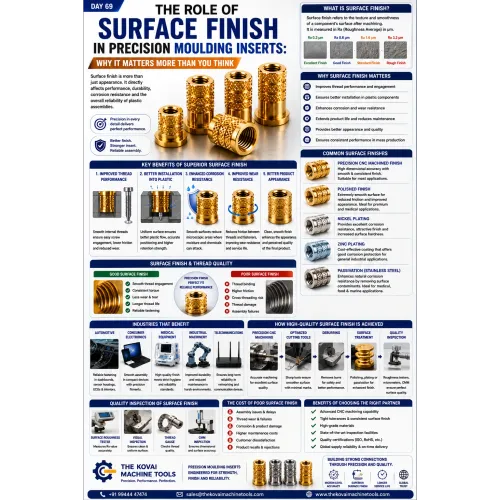
In today's competitive manufacturing environment, product performance, durability, and reliability depend on selecting the right components. One small but critical component that significantly influences the strength of plastic assemblies is the moulding insert.
Moulding inserts are widely used in industries such as automotive, electronics, medical devices, telecommunications, consumer products, and industrial machinery. They provide durable metal threads inside plastic components, allowing secure fastening and repeated assembly without damaging the plastic material.
When selecting moulding inserts, manufacturers often face a common question:
Should we use Standard Moulding Inserts or Custom Moulding Inserts?
Both options offer advantages, but the right choice depends entirely on the application's design, performance requirements, production volume, and operating environment.
In this article, we will explore the differences between custom moulding inserts and standard moulding inserts, helping engineers, product designers, and procurement teams make informed decisions.
Understanding Moulding Inserts
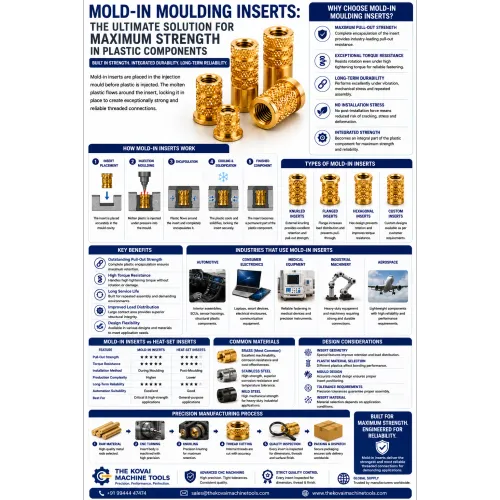
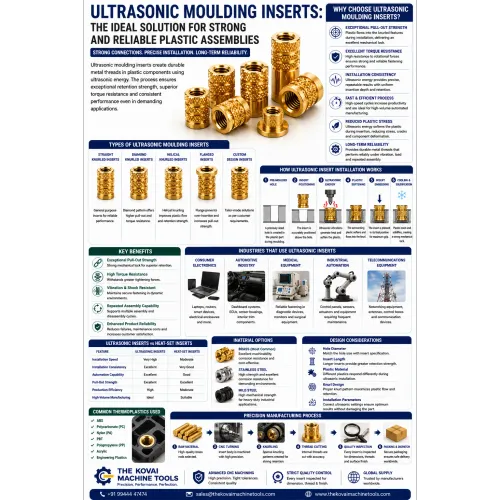
Moulding inserts are precision-engineered metal components embedded into plastic parts to provide:
- Strong internal threads
- Improved fastening reliability
- Resistance to thread stripping
- Enhanced load-bearing capacity
- Longer product life
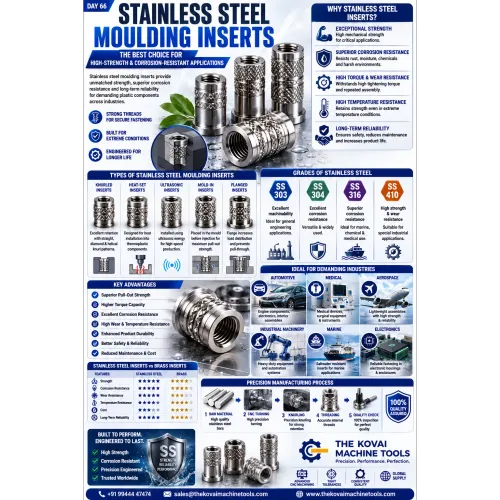
These inserts are manufactured from materials such as:
- Brass
- Stainless Steel
- Mild Steel
- Aluminium
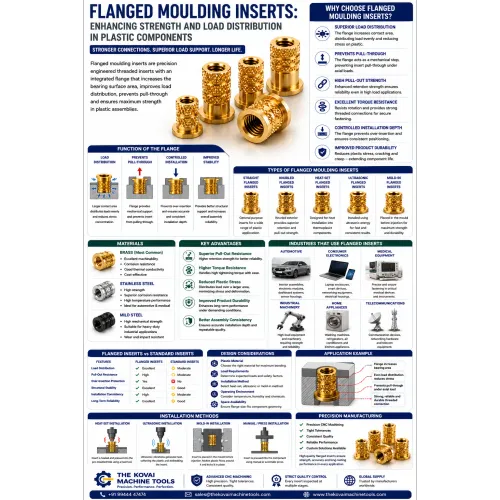
Depending on the application, inserts may be installed using:
- Heat-set installation
- Ultrasonic installation
- Press-fit installation
- Mold-in installation
The effectiveness of an insert depends on both its design and manufacturing precision.
What Are Standard Moulding Inserts?
Standard moulding inserts are manufactured according to commonly accepted industry specifications and dimensions.
These inserts are typically available in:
- Standard metric thread sizes
- Standard knurling patterns
- Common lengths and diameters
- Industry-standard designs
Because they are mass-produced, standard inserts are readily available and suitable for a wide range of applications.
Advantages of Standard Moulding Inserts
Immediate Availability
One of the biggest benefits of standard inserts is quick availability.
Manufacturers can often source them without long lead times.
This helps reduce production delays.
Lower Initial Cost
Because standard inserts are produced in large volumes, tooling and manufacturing costs are spread across many customers.
This makes them more economical for general applications.
Proven Designs
Standard inserts have been widely used across industries for years.
Their performance characteristics are well established and predictable.
Simplified Procurement
Purchasing standard inserts is often easier because dimensions and specifications are already defined.
Limitations of Standard Inserts
While standard inserts work well in many applications, they may not always meet specialized requirements.
Common limitations include:
Limited Design Flexibility
Standard inserts may not fit unique product designs.
Performance Constraints
Specific load requirements may exceed the capabilities of standard inserts.
Space Restrictions
Miniaturized products often require custom dimensions.
Special Material Requirements
Certain industries may require specialized materials or coatings.
When these challenges arise, custom moulding inserts become the preferred solution.
What Are Custom Moulding Inserts?
Custom moulding inserts are specifically engineered and manufactured according to customer requirements.
Every aspect can be customized, including:
- Thread size
- Length
- Diameter
- Knurling pattern
- Material selection
- Surface finish
- Flange design
- Retention features
Custom inserts are developed to meet precise application needs.
Advantages of Custom Moulding Inserts
1. Optimized Product Performance
Custom inserts are designed specifically for the application.
This ensures:
- Better retention
- Improved pull-out resistance
- Enhanced load distribution
- Superior fastening performance
As a result, product reliability increases significantly.
2. Perfect Fit for Unique Designs
Many modern products have complex geometries and compact designs.
Custom inserts can be manufactured to fit:
- Thin-wall plastic components
- Miniature assemblies
- Specialized housings
- Space-constrained applications
This flexibility allows engineers greater design freedom.
3. Material Selection Based on Application
Custom inserts allow manufacturers to choose materials according to environmental and mechanical requirements.
Examples include:
Brass Inserts
Ideal for:
- Heat-set applications
- Electrical products
- General engineering
Stainless Steel Inserts
Ideal for:
- Corrosive environments
- Automotive systems
- Medical equipment
Mild Steel Inserts
Suitable for:
- Heavy-duty industrial applications
Aluminium Inserts
Used where lightweight design is critical.
4. Improved Assembly Efficiency
Custom inserts can be designed specifically for automated assembly systems.
This helps:
- Reduce installation errors
- Improve production speed
- Lower labor costs
Automation compatibility is increasingly important in modern manufacturing.
5. Enhanced Product Life
Custom designs allow engineers to optimize:
- Knurling patterns
- Retention geometry
- Thread engagement
These improvements result in:
- Stronger fastening
- Better vibration resistance
- Longer service life
Industries That Commonly Use Custom Moulding Inserts
Automotive Industry
Vehicle manufacturers often require custom inserts for:
- Electronic modules
- Dashboard systems
- Sensor housings
- EV battery assemblies
Medical Equipment
Medical devices frequently require:
- Precision dimensions
- Specialized materials
- High reliability
Custom inserts help meet these requirements.
Consumer Electronics
Miniaturized products often need custom insert designs to fit compact spaces.
Applications include:
- Smartphones
- Laptops
- Networking devices
- Smart appliances
Industrial Machinery
Heavy-duty equipment often requires custom inserts capable of handling extreme loads and operating conditions.
Comparing Standard vs Custom Moulding Inserts
FeatureStandard InsertsCustom InsertsAvailabilityImmediateRequires DevelopmentInitial CostLowerHigherDesign FlexibilityLimitedExcellentPerformance OptimizationStandardApplication-SpecificMaterial OptionsLimitedExtensiveSpace AdaptabilityModerateExcellentAutomation CompatibilityGeneralCustomizableProduct Life OptimizationStandardSuperiorWhen Should You Choose Standard Inserts?
Standard inserts are often the best choice when:
✔ Product requirements are straightforward
✔ Production deadlines are short
✔ Cost sensitivity is high
✔ Standard dimensions meet design needs
✔ Moderate performance is acceptable
When Should You Choose Custom Inserts?
Custom inserts are recommended when:
✔ Product performance is critical
✔ Unique dimensions are required
✔ Space limitations exist
✔ Specialized materials are needed
✔ High pull-out resistance is required
✔ Long-term reliability is essential
✔ Automated assembly systems are involved
The Importance of Precision Manufacturing
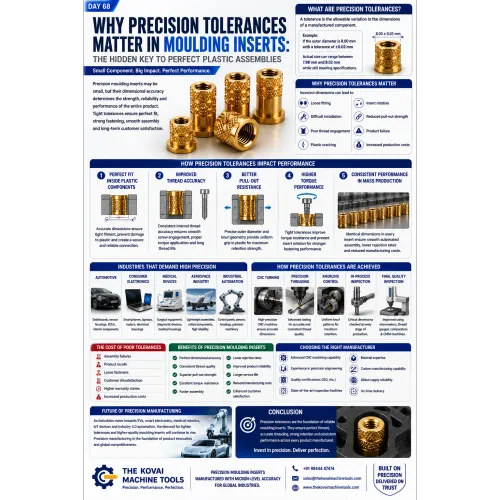
Whether standard or custom, insert performance ultimately depends on manufacturing quality.
High-quality moulding inserts require:
- CNC precision machining
- Accurate threading
- Consistent knurling
- Tight tolerances
- Rigorous quality inspection
Precision manufacturing ensures reliable performance throughout the product lifecycle.
Why Leading Manufacturers Choose Custom Solutions
Many global manufacturers increasingly choose custom moulding inserts because they understand that:
A perfectly optimized insert often delivers greater long-term value than a standard insert.
Benefits include:
- Reduced assembly failures
- Improved product durability
- Lower warranty claims
- Better customer satisfaction
These advantages often outweigh the initial development investment.
Conclusion
Both standard and custom moulding inserts play important roles in modern manufacturing.
Standard inserts provide:
- Cost efficiency
- Fast availability
- Proven performance
Custom inserts provide:
- Optimized design
- Superior performance
- Greater flexibility
- Enhanced durability
The right choice depends on your product requirements, production goals, and performance expectations.
For applications where reliability, precision, and long-term durability matter most, custom moulding inserts often provide the greatest value.
Call to Action
Looking for Custom Moulding Inserts, Brass Inserts, Stainless Steel Inserts, Heat-Set Inserts, or Precision CNC Turned Components?
The Kovai Machine Tools specializes in manufacturing precision-engineered moulding inserts tailored to customer requirements worldwide.
Our Expertise Includes:
✅ Custom Moulding Inserts
✅ Brass Threaded Inserts
✅ Stainless Steel Inserts
✅ Heat-Set & Ultrasonic Inserts
✅ Knurled Inserts
✅ Flanged Inserts
✅ CNC Precision Turned Components
✅ High-Volume Production Capability
📞 Contact us today to discuss your application requirements and receive a customized engineering solution.
Partner with a trusted precision manufacturing expert and achieve stronger fastening, longer product life, and superior product performance with custom moulding inserts. 🚀
Keywords