
Different Types of Moulding Inserts Widely Used in Industrial Applications
Introduction
Plastic injection moulding has become one of the most efficient manufacturing processes used across modern industries. From automotive components and consumer electronics to industrial equipment and household appliances, plastic parts are widely used because they are lightweight, corrosion-resistant, and cost-effective to produce.
However, plastic materials alone often cannot provide the strength required for threaded fastening, mechanical assembly, and structural reinforcement. This is why manufacturers use moulding inserts.
Moulding inserts are precision-machined metal components embedded into plastic parts to create strong internal threads, improve durability, and enhance overall product performance.
Today, many industries rely on different types of moulding inserts depending on the product design, installation method, and application requirements.
In this article, we will explore the different types of moulding inserts widely used in industry, their applications, and how they help improve the reliability of plastic components.
What Are Moulding Inserts?
Moulding inserts are metal components designed to be embedded into plastic parts during or after the injection moulding process. These inserts provide strong threaded connections that plastic alone cannot achieve.
They are typically manufactured using precision CNC turning and machining processes to ensure accurate thread profiles and tight tolerances.
Common materials used to manufacture moulding inserts include:
- Brass
- Stainless Steel
- Mild Steel
- Aluminium
These materials provide strength, durability, and corrosion resistance, making them ideal for various industrial applications.
Why Moulding Inserts Are Used in Plastic Components
Manufacturers use moulding inserts because they solve several limitations associated with plastic parts.
Stronger Threads
Plastic threads can wear out or strip easily. Metal inserts provide durable internal threads that allow screws and bolts to be tightened securely.
Improved Durability
Inserts reinforce plastic components, making them stronger and more resistant to mechanical stress.
Higher Load Capacity
Metal inserts allow plastic parts to handle greater tightening torque and mechanical loads.
Longer Product Life
By preventing thread wear and structural damage, moulding inserts significantly increase the lifespan of plastic components.
Different Types of Moulding Inserts Used in Industry
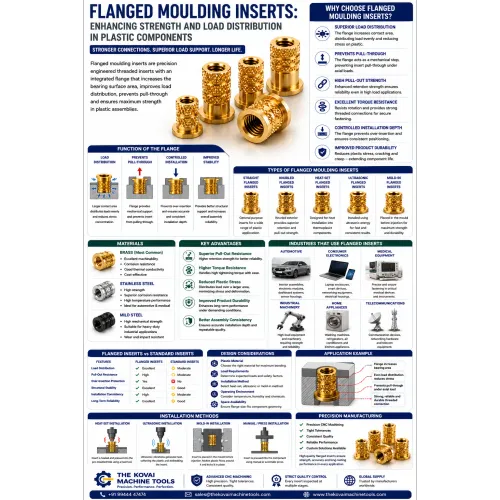
Several types of moulding inserts are used depending on the application and installation method.
1. Threaded Inserts
Threaded inserts are the most commonly used moulding inserts in plastic components.
These inserts provide strong internal threads that allow screws and bolts to be fastened securely.
Key Features
- Precision internal threading
- Durable metal threads
- Resistant to wear and repeated assembly
Common Applications
Threaded inserts are widely used in:
- Automotive plastic parts
- Electronic enclosures
- Industrial equipment
- Consumer appliances
They are essential for products that require reliable threaded connections.
2. Press-Fit Inserts
Press-fit inserts are installed into plastic components by applying pressure.
These inserts are designed with knurled or textured outer surfaces that grip the plastic tightly and prevent movement.
Advantages
- Simple installation
- Strong retention in plastic parts
- Cost-effective solution
Industrial Applications
Press-fit inserts are commonly used in:
- Plastic housings
- Electrical equipment
- Consumer electronics
They are ideal for high-volume manufacturing.
3. Heat-Set Inserts
Heat-set inserts are installed using heat, which softens the surrounding plastic during installation.
Once the plastic cools, it hardens around the insert, locking it securely in place.
Benefits
- Strong bonding with plastic
- Excellent resistance to pull-out
- Long-term stability
Common Uses
Heat-set inserts are widely used in:
- Electronic products
- Plastic assemblies requiring high strength
- Components requiring repeated assembly
This method ensures a strong and permanent connection.
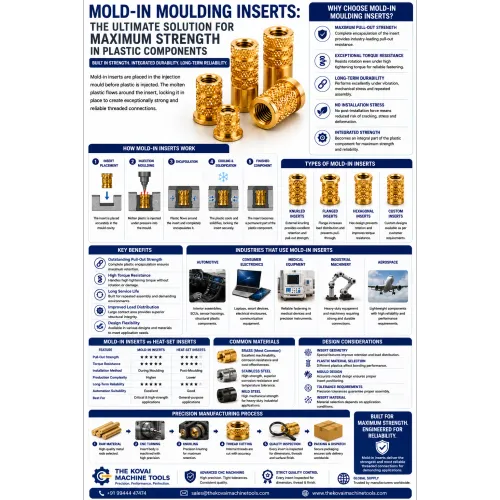
4. Mold-In Inserts
Mold-in inserts are placed inside the mould before the plastic injection process begins.
During moulding, the molten plastic flows around the insert and solidifies, embedding it directly into the part.
Advantages
- Maximum strength and stability
- Strong bond between plastic and metal
- Ideal for high-performance applications
Applications
Mold-in inserts are commonly used in:
- Automotive components
- Industrial equipment
- High-load plastic parts
This method is widely used in applications requiring strong structural reinforcement.
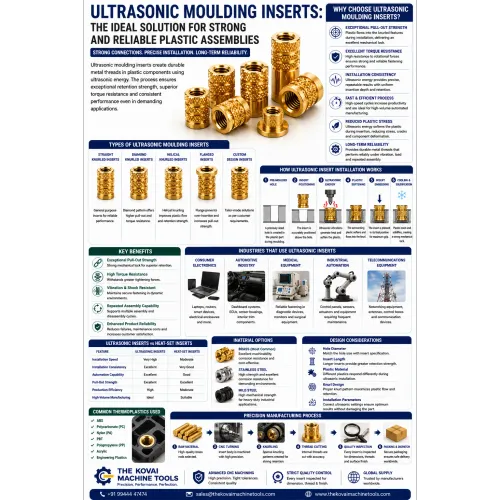
5. Ultrasonic Inserts
Ultrasonic inserts are installed using ultrasonic vibration.
The vibration generates heat that softens the plastic, allowing the insert to be embedded into the component.
Key Benefits
- Precise installation
- Strong bonding with plastic
- Suitable for automated manufacturing
Applications
Ultrasonic inserts are commonly used in:
- Electronics manufacturing
- Plastic assemblies with tight tolerances
- Precision plastic components
6. Self-Tapping Inserts
Self-tapping inserts are designed to cut their own threads during installation.
These inserts are installed by screwing them into the plastic component.
Advantages
- No pre-threading required
- Easy installation
- Strong thread engagement
Industrial Uses
Self-tapping inserts are often used in:
- Repair applications
- Low-volume production
- Maintenance of plastic components
Materials Used for Moulding Inserts
The performance of moulding inserts depends largely on the materials used in their manufacturing.
Brass
Brass is one of the most commonly used materials for moulding inserts because of its excellent machinability and corrosion resistance.
Brass inserts provide smooth threads and reliable performance.
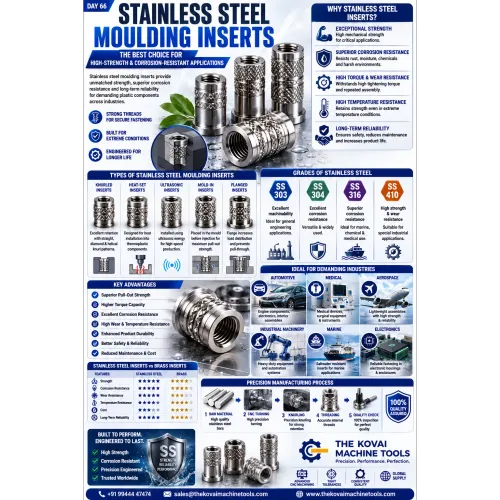
Stainless Steel
Stainless steel inserts offer high strength and excellent resistance to corrosion.
They are used in applications requiring durability and performance in harsh environments.
Mild Steel
Mild steel inserts provide strong mechanical properties and are used in heavy-duty industrial applications.
Aluminium
Aluminium inserts are used in lightweight applications where reducing weight is important.
Industries That Use Moulding Inserts
Moulding inserts are used across many industries that rely on plastic components.
Automotive Industry
Automotive manufacturers use inserts in plastic parts that require reliable threaded fastening.
Consumer Electronics
Electronic devices use moulding inserts to secure plastic housings and internal components.
Industrial Machinery
Machinery manufacturers rely on inserts to reinforce plastic components used in equipment and assemblies.
Appliance Manufacturing
Household appliances use inserts to ensure strong and durable threaded connections.
Importance of Precision Manufacturing
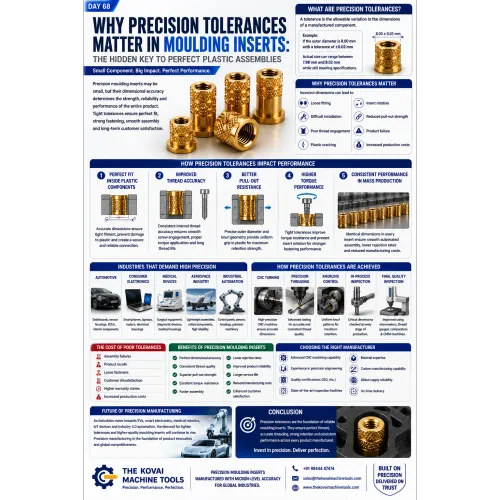
The quality and performance of moulding inserts depend on precision manufacturing and tight tolerance control.
High-quality inserts must be manufactured with:
- Accurate thread profiles
- Consistent dimensions
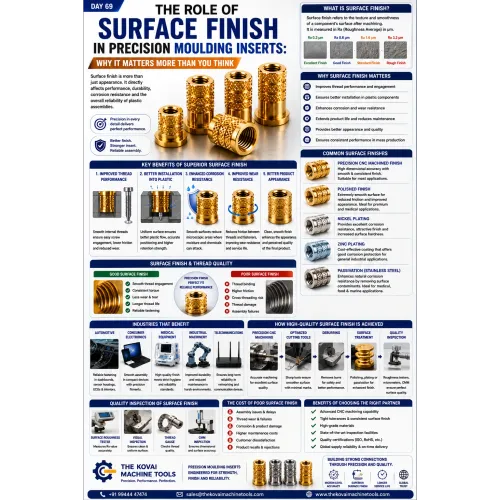
- Smooth surface finishes
- High material quality
Precision CNC machining ensures that moulding inserts meet the exact requirements of modern industrial applications.
Conclusion
Moulding inserts play a critical role in improving the strength, durability, and reliability of plastic components used across many industries.
Different types of inserts such as threaded inserts, press-fit inserts, heat-set inserts, mold-in inserts, ultrasonic inserts, and self-tapping inserts are widely used depending on the application and installation method.
By selecting the right type of insert and using precision manufacturing processes, manufacturers can significantly enhance the performance and lifespan of plastic products.
As industries continue to demand stronger and more reliable components, moulding inserts will remain an essential part of modern engineering and product design.
Call to Action
If your manufacturing process requires high-quality precision moulding inserts or custom CNC turned components, choosing the right manufacturing partner is essential.
The Kovai Machine Tools specializes in manufacturing precision moulding inserts, rivets, bushes, shafts, and other turned components designed for modern industrial applications.
With expertise in precision machining and high-quality engineering materials, we deliver components that ensure strength, accuracy, and long-term reliability.
📞 Contact us today to discuss your requirements or request a quotation for precision moulding inserts tailored to your application.
Work with a trusted precision component manufacturer and improve the performance of your products with high-quality moulding inserts. 🚀
Keywords