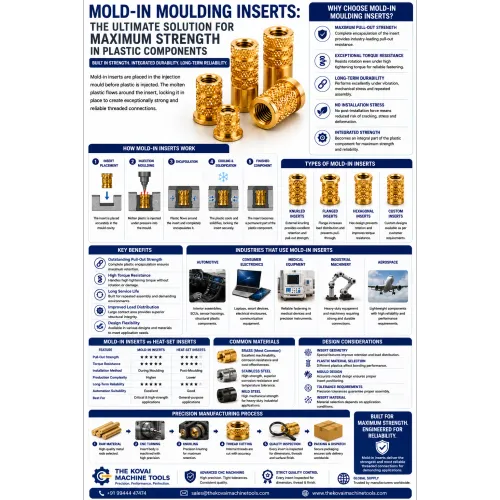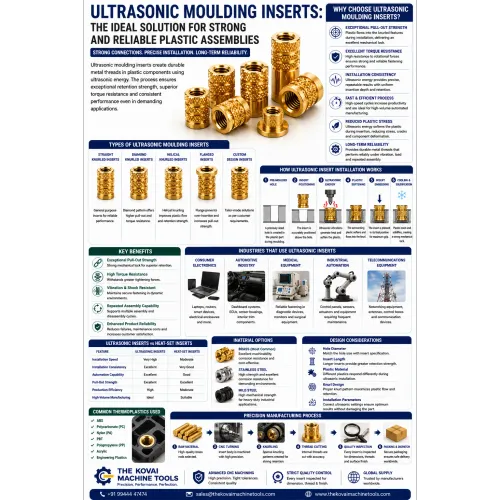

Heat-Set Inserts: The Preferred Choice for High-Strength Plastic Assemblies
Introduction
As industries continue to adopt lightweight plastic components in place of heavier metal parts, the demand for reliable fastening solutions has grown significantly. Plastic materials offer many advantages such as lower weight, corrosion resistance, design flexibility, and cost-effective manufacturing. However, plastic alone often lacks the strength required for durable threaded connections.
This is where Heat-Set Inserts have become one of the most trusted solutions in modern manufacturing.
Heat-set inserts are precision-engineered metal threaded inserts designed specifically for plastic components. By using heat during installation, these inserts create a strong mechanical bond with the surrounding plastic, resulting in superior retention strength and long-lasting performance.
Today, heat-set inserts are widely used across industries including:
- Automotive
- Electronics
- Medical Devices
- Consumer Products
- Telecommunications
- Industrial Equipment
Their ability to provide strong, reusable threads inside plastic components has made them a preferred choice for engineers worldwide.
In this article, we will explore how heat-set inserts work, their advantages, applications, and why they are often considered the gold standard for high-strength plastic assemblies.
What Are Heat-Set Inserts?
Heat-set inserts are metal threaded inserts designed to be installed into thermoplastic components using controlled heat.
Unlike press-fit inserts that rely purely on mechanical force, heat-set inserts use thermal energy to soften the surrounding plastic during installation.
As the plastic cools, it flows around the insert's knurled surface and solidifies, creating a highly secure mechanical bond.
The result is:
- Strong internal threads
- High pull-out resistance
- Excellent torque resistance
- Long-term fastening reliability
Heat-set inserts are commonly manufactured from:
- Brass
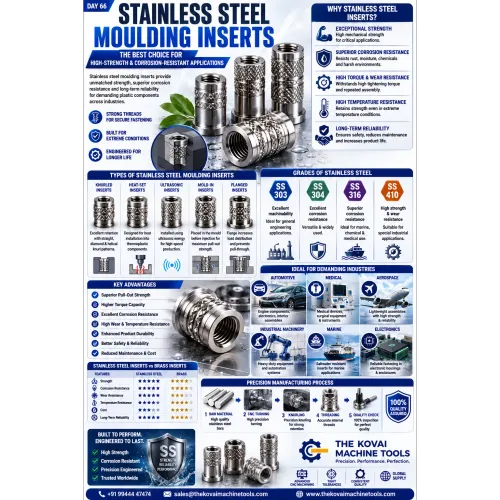
- Stainless Steel
- Aluminum
- Specialized engineering alloys
Among these materials, Brass Heat-Set Inserts remain the most popular due to their excellent thermal conductivity and machinability.
How Heat-Set Inserts Work
The installation process is relatively simple but highly effective.
Step 1: Prepare the Hole
A pre-molded or machined hole is created in the plastic component.
Step 2: Apply Controlled Heat
A specialized heat-setting tool heats the insert.
Step 3: Insert Placement
The heated insert is pressed into the hole.
As the insert enters the plastic, the surrounding material softens and flows around the knurling.
Step 4: Cooling and Bonding
After installation, the plastic cools and solidifies.
The plastic permanently locks around the insert's retention features.
This creates a strong and reliable threaded connection.
Why Heat-Set Inserts Are Preferred
Many fastening solutions exist for plastic components, but heat-set inserts offer unique advantages that make them the preferred choice in many applications.
1. Superior Pull-Out Strength
One of the biggest benefits of heat-set inserts is exceptional pull-out resistance.
Because the plastic flows around the insert during installation, a strong mechanical interlock is formed.
This significantly increases retention strength compared to standard press-fit methods.
For products exposed to:
- Vibration
- Mechanical loads
- Repeated assembly
This added strength is critical.
2. Excellent Torque Resistance
Threaded connections must withstand tightening forces.
Heat-set inserts provide superior torque performance because the insert is securely bonded to the plastic.
This prevents:
- Insert rotation
- Loosening
- Thread damage
The result is more reliable fastening throughout the product's life.
3. Reusable Threads
Plastic threads often wear out after repeated assembly and disassembly.
Heat-set inserts provide durable metal threads that can withstand multiple fastening cycles without degradation.
This makes them ideal for:
- Serviceable products
- Maintenance applications
- Modular equipment
4. Improved Product Durability
Products with heat-set inserts generally have:
- Longer lifespan
- Better mechanical performance
- Reduced maintenance requirements
This improves overall customer satisfaction and product reliability.
5. Ideal for Automated Manufacturing
Modern production facilities increasingly rely on automation.
Heat-set inserts can be installed using:
- Automated insertion equipment
- Robotic systems
- High-volume production lines
This improves manufacturing efficiency and consistency.
Common Types of Heat-Set Inserts
Several heat-set insert designs are available depending on application requirements.
Straight Knurl Inserts
Feature parallel knurling patterns.
Suitable for general-purpose applications.
Diamond Knurl Inserts
Provide excellent retention and resistance to rotation.
Widely used in high-performance assemblies.
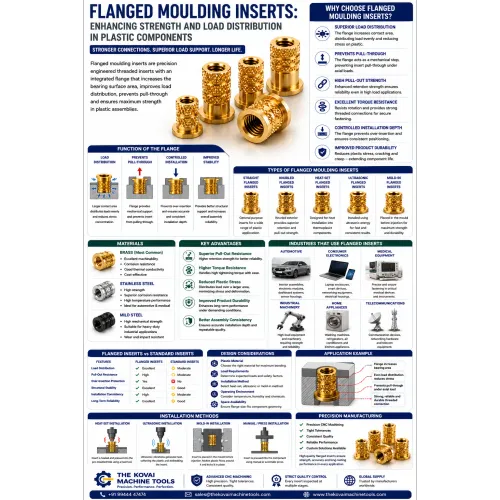
Flanged Heat-Set Inserts
Include a flange for additional support and load distribution.
Ideal for high-load applications.
Symmetrical Inserts
Designed for automated installation systems.
Can be inserted from either side.
Why Brass Is the Preferred Material
Brass is the most commonly used material for heat-set inserts because it offers:
Excellent Thermal Conductivity
Heat transfers efficiently into the surrounding plastic.
Precision Machining
Brass allows highly accurate threads and knurling patterns.
Corrosion Resistance
Suitable for most industrial environments.
Cost Efficiency
Provides excellent performance at competitive cost.
These advantages make brass inserts the preferred choice across multiple industries.
Industries That Depend on Heat-Set Inserts
Automotive Industry
Used in:
- Dashboard assemblies
- Sensor housings
- Interior trim components
- EV battery systems
Heat-set inserts provide reliable fastening under vibration and temperature variations.
Consumer Electronics
Found in:
- Laptops
- Routers
- Smart devices
- Gaming equipment
They provide strong reusable threads within plastic enclosures.
Medical Devices
Medical equipment requires precise and durable fastening.
Heat-set inserts help ensure product safety and reliability.
Telecommunications
Networking and communication equipment often use heat-set inserts for secure assembly.
Industrial Equipment
Machinery and automation systems rely on heat-set inserts for long-lasting performance.
Heat-Set Inserts vs Press-Fit Inserts
FeatureHeat-Set InsertsPress-Fit InsertsPull-Out StrengthExcellentModerateTorque ResistanceExcellentGoodThread DurabilityExcellentGoodInstallation MethodThermalMechanicalPlastic StressMinimalHigherLong-Term ReliabilityExcellentModerateAutomation CompatibilityExcellentGood
For demanding applications, heat-set inserts often outperform press-fit alternatives.
Factors to Consider When Choosing Heat-Set Inserts
When selecting heat-set inserts, manufacturers should evaluate:
Plastic Material
Different plastics respond differently to heat installation.
Load Requirements
Higher loads may require specialized insert designs.
Thread Size
Thread dimensions should match fastening requirements.
Installation Method
Manual, semi-automated, or fully automated production.
Environmental Conditions
Temperature, moisture, vibration, and chemical exposure all influence material selection.
The Importance of Precision Manufacturing
The performance of heat-set inserts depends heavily on manufacturing accuracy.
Precision machining ensures:
- Accurate threads
- Consistent knurling
- Tight tolerances
- Reliable installation
High-quality inserts reduce assembly problems and improve product performance.
Future Demand for Heat-Set Inserts
As industries increasingly use engineering plastics and lightweight designs, demand for heat-set inserts continues to grow.
Emerging sectors such as:
- Electric Vehicles (EVs)
- Smart Electronics
- Medical Technology
- Industrial Automation
are driving greater demand for reliable plastic fastening solutions.
Heat-set inserts are expected to remain one of the most important fastening technologies for modern manufacturing.
Conclusion
Heat-set inserts have become the preferred fastening solution for high-strength plastic assemblies because they offer:
- Exceptional pull-out resistance
- Superior torque performance
- Reusable metal threads
- Long product life
- Excellent manufacturing efficiency
Their ability to create strong, reliable threaded connections in plastic components makes them indispensable across countless industries.
For manufacturers seeking durability, reliability, and performance, heat-set inserts continue to be one of the best solutions available.
Call to Action
Looking for Precision Heat-Set Inserts, Brass Threaded Inserts, Stainless Steel Inserts, or Custom Moulding Inserts?
The Kovai Machine Tools manufactures high-quality precision moulding inserts designed for industries worldwide.
Our Product Range Includes:
✅ Brass Heat-Set Inserts
✅ Stainless Steel Inserts
✅ Ultrasonic Inserts
✅ Knurled Inserts
✅ Flanged Inserts
✅ Custom CNC Turned Components
✅ Precision Threaded Inserts
✅ High-Volume Manufacturing Solutions
Keywords