
How Moulding Inserts Improve Strength in Plastic Components
Introduction
Plastic components are widely used in modern manufacturing because they are lightweight, cost-effective, and easy to produce through injection moulding. Industries such as automotive, electronics, consumer appliances, and industrial equipment rely heavily on plastic parts for their products.
However, plastic alone cannot always provide the strength and durability required for threaded fastening or mechanical assembly. When screws or bolts are tightened directly into plastic, the threads can easily strip, wear out, or fail over time.
This is why manufacturers use precision moulding inserts.
Moulding inserts are specially designed metal components embedded into plastic parts to provide strong and reliable threads. By combining the flexibility of plastic with the strength of metal, these inserts significantly improve the performance and durability of plastic products.
In this article, we will explore how moulding inserts strengthen plastic components, why manufacturers rely on them, and how they improve product reliability across various industries.
The Challenge with Plastic Threads
Plastic materials such as ABS, Nylon, Polycarbonate, and other engineering plastics are widely used in injection moulding. While these materials offer many advantages, they also have certain limitations.
Some of the common challenges with plastic threads include:
Thread Stripping
Plastic threads can easily wear out or strip when screws are tightened repeatedly. This is especially common in products that require frequent maintenance or disassembly.
Limited Load Capacity
Plastic cannot withstand the same tightening torque as metal. When excessive force is applied, the threads can deform or crack.
Wear and Tear
Over time, repeated use can weaken plastic threads, causing loose fasteners and unreliable assembly.
Thermal Expansion
Plastic expands and contracts with temperature changes, which can weaken threaded connections.
Because of these limitations, manufacturers use moulding inserts to reinforce plastic components and improve their strength.
What Are Moulding Inserts?
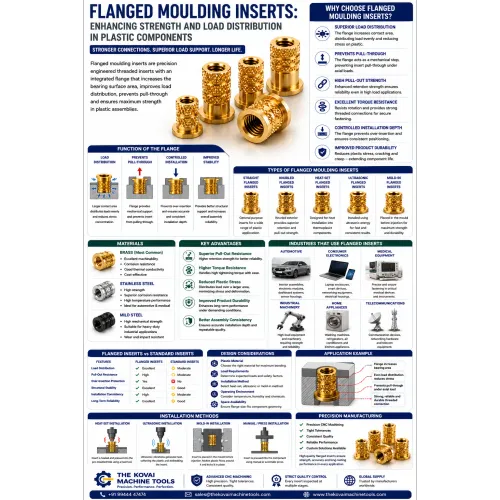
Moulding inserts are precision-machined metal components that are embedded into plastic parts to provide durable threaded connections.
These inserts are typically manufactured using CNC turning and precision machining processes, ensuring accurate dimensions and consistent quality.
Once installed, the insert becomes a permanent part of the plastic component, allowing screws or bolts to be tightened securely without damaging the surrounding material.
How Moulding Inserts Strengthen Plastic Components
1. Reinforcing the Threaded Area
The most common reason for using moulding inserts is to reinforce the threaded portion of a plastic component.
Instead of relying on plastic threads, the insert provides strong metal threads that can withstand repeated tightening and loosening without damage.
This makes the component more durable and reliable.
2. Increasing Torque Resistance
Metal inserts allow screws to be tightened with higher torque compared to plastic threads.
This is important in applications where strong fastening is required, such as:
- Automotive assemblies
- Industrial machinery
- Electrical enclosures
- Structural plastic parts
By using moulding inserts, manufacturers can ensure that fasteners remain secure even under heavy loads.
3. Preventing Thread Wear
Plastic threads can wear out quickly, especially when subjected to repeated assembly cycles.
Metal inserts provide long-lasting threads that resist wear, ensuring the product remains functional for a longer period.
This is particularly beneficial in products that require maintenance or frequent servicing.
4. Improving Load Distribution
When screws are tightened directly into plastic, the stress is concentrated in a small area. This can cause cracks or deformation over time.
Moulding inserts distribute the load more evenly across the plastic component, reducing the risk of failure.
This improves both the strength and lifespan of the product.
5. Preventing Component Failure
Weak threaded connections can lead to product failure, which may cause operational issues or safety concerns.
By using precision moulding inserts, manufacturers can prevent:
- Thread stripping
- Loose fasteners
- Cracked plastic parts
- Assembly failures
This makes moulding inserts an essential component in many engineered products.
Methods of Installing Moulding Inserts
There are several methods used to install moulding inserts into plastic components. The choice of method depends on the design of the product and the manufacturing process.
Press-Fit Inserts
Press-fit inserts are installed by applying pressure to push the insert into a pre-moulded hole in the plastic part.
They are designed with knurled surfaces that grip the plastic securely.
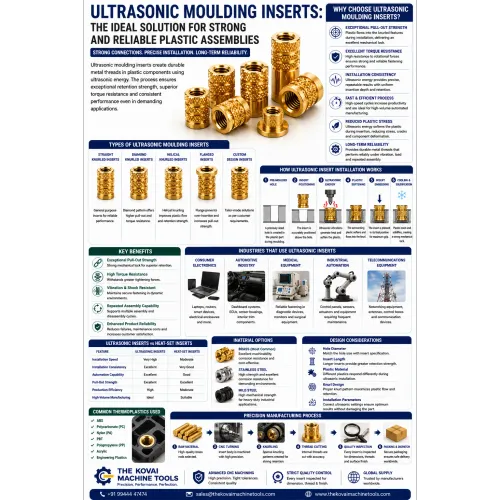
Heat-Set Inserts
Heat-set inserts are installed using heat, which softens the surrounding plastic. Once the plastic cools, the insert is locked firmly in place.
This method provides strong and stable installation.
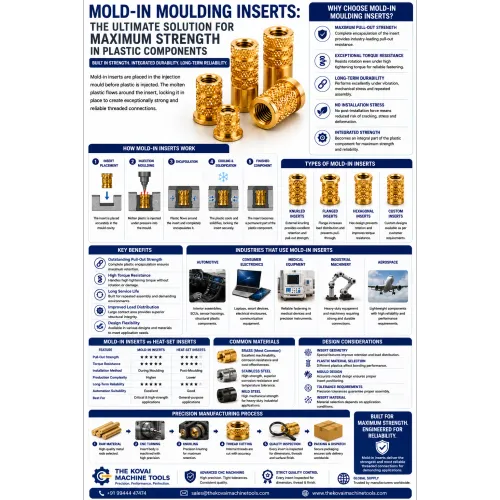
Mold-In Inserts
In this method, the insert is placed inside the mould before the plastic injection process begins. The plastic is then moulded around the insert.
This creates a strong bond between the plastic and the metal insert.
Materials Used for Moulding Inserts
Different materials are used to manufacture moulding inserts depending on the application requirements.
Brass
Brass is widely used because of its excellent machinability and corrosion resistance.
Brass inserts also provide smooth threading and reliable performance.
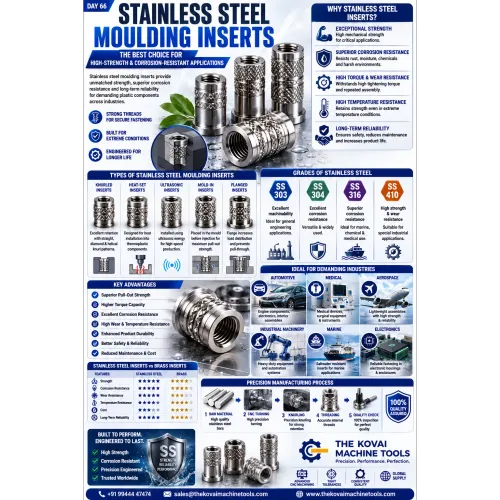
Stainless Steel
Stainless steel inserts are used in applications requiring high strength and resistance to corrosion.
They are commonly used in automotive and industrial environments.
Mild Steel
Mild steel inserts offer high strength and are suitable for heavy-duty mechanical applications.
Aluminium
Aluminium inserts are used in lightweight applications where reducing weight is important.
Applications of Moulding Inserts
Precision moulding inserts are used across many industries that require reliable fastening in plastic components.
Automotive Industry
Automotive manufacturers use inserts in interior panels, electronic housings, and structural plastic components.
Consumer Electronics
Electronic devices use inserts to secure plastic enclosures and internal components.
Industrial Equipment
Machinery and equipment manufacturers rely on inserts to create durable threaded connections in plastic parts.
Appliance Manufacturing
Home appliances use inserts to ensure strong assembly of plastic housings and internal components.
Importance of Precision Manufacturing
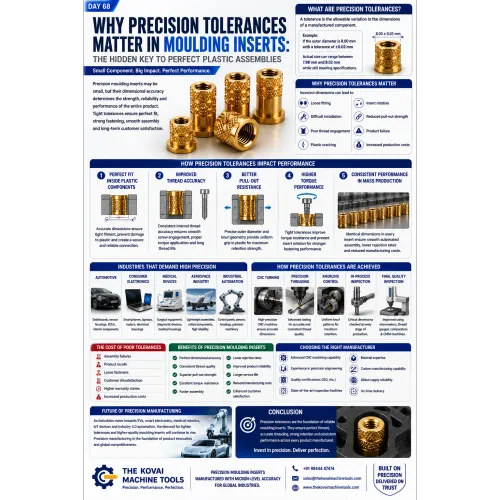
The performance of moulding inserts depends heavily on manufacturing accuracy.
Precision machining ensures that inserts have:
- Accurate thread profiles
- Tight tolerances
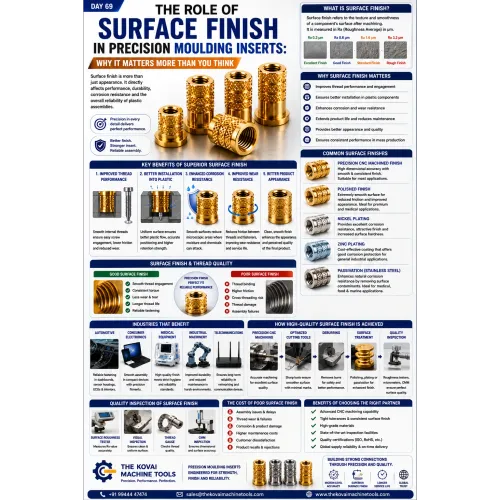
- Smooth surface finishes
- Consistent dimensions
High-quality manufacturing prevents issues such as poor fit, misalignment, or weak fastening.
This is why manufacturers prefer suppliers with strong expertise in precision CNC machining and turned components.
Why Manufacturers Rely on Precision Moulding Inserts
Manufacturers choose moulding inserts because they offer several key advantages:
- Strong and durable threaded connections
- Improved product reliability
- Increased assembly efficiency
- Longer product lifespan
- Reduced maintenance issues
By integrating metal inserts into plastic parts, manufacturers can produce high-performance components that meet modern engineering requirements.
Conclusion
Plastic injection moulding allows manufacturers to produce lightweight and cost-effective components, but plastic alone cannot provide the strength needed for reliable threaded connections.
Precision moulding inserts solve this challenge by reinforcing plastic components with durable metal threads.
They improve strength, prevent thread damage, increase torque resistance, and enhance overall product reliability.
Because of these benefits, moulding inserts have become an essential component in industries such as automotive, electronics, industrial machinery, and consumer products.
Call to Action
If your products require reliable threaded connections in plastic components, high-quality precision moulding inserts are essential.
The Kovai Machine Tools manufactures precision moulding inserts, rivets, bushes, shafts, and other CNC turned components designed to meet the demanding requirements of modern industries.
With expertise in precision machining and high-quality engineering materials, we deliver components that ensure durability, accuracy, and reliable performance.
📞 Contact us today to discuss your requirements or request a quote for precision moulding inserts tailored to your application.
Partner with a trusted precision component manufacturer and ensure the strength and reliability of your products. 🚀
Keywords