
Knurling Matters in Precision Brass Moulding Inserts
Introduction
When manufacturers select moulding inserts for plastic components, they often focus on factors such as thread quality, material strength, dimensional accuracy, and corrosion resistance. While all these factors are important, there is another critical feature that significantly impacts insert performance but is often overlooked—knurling.
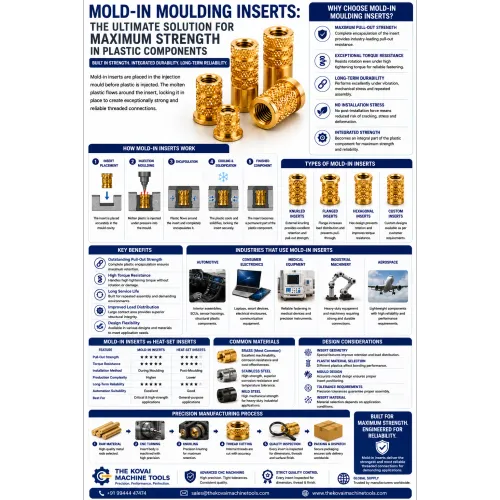
Knurling is the specially engineered pattern found on the outer surface of a moulding insert. Although it may appear to be a simple textured design, knurling plays a vital role in ensuring the insert remains securely locked inside the plastic component throughout the product's life cycle.
In industries such as automotive, consumer electronics, electrical equipment, medical devices, telecommunications, and industrial machinery, moulding inserts must withstand vibration, repeated assembly, torque loads, and environmental stress. Without proper retention features, inserts can rotate, loosen, or pull out from the plastic component.
This is where precision-engineered knurling becomes essential.
In this article, we will explore why knurling matters in precision brass moulding inserts, how it improves product reliability, and why manufacturers worldwide insist on high-quality knurled inserts for their plastic components.
What Is Knurling in Moulding Inserts?
Knurling refers to the patterned texture machined onto the external surface of a moulding insert.
These patterns are designed to create a strong mechanical grip between the insert and the surrounding plastic material.
Instead of relying solely on friction, the knurled surface allows the plastic to flow into the grooves and patterns during installation, creating a secure lock that improves retention strength.
Knurling is commonly used on:
- Brass moulding inserts
- Heat-set inserts
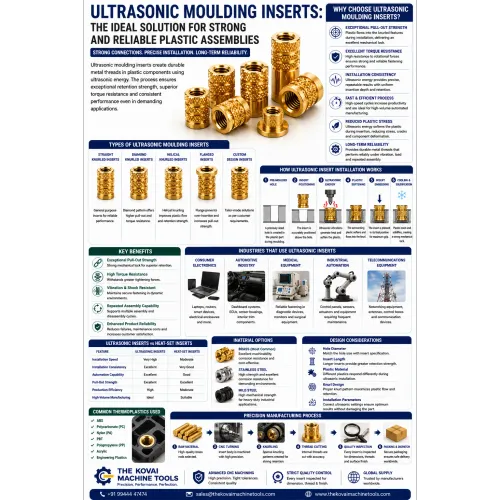
- Ultrasonic inserts
- Press-fit inserts
- Threaded inserts
The quality and design of the knurling directly influence the insert's performance inside the plastic component.
Why Is Knurling Important?
Without knurling, a moulding insert would have a relatively smooth outer surface.
This could lead to several problems:
- Insert rotation during screw tightening
- Pull-out under load
- Weak retention in plastic
- Reduced assembly reliability
- Shorter product lifespan
Knurling solves these issues by increasing the mechanical interlocking between the insert and the plastic material.
Key Benefits of Knurling in Brass Moulding Inserts
1. Prevents Insert Rotation
One of the most important functions of knurling is preventing insert rotation.
When a screw is tightened into an insert, torque is transferred to the insert body.
If the insert rotates inside the plastic component:
- Assembly becomes difficult
- Thread engagement is affected
- Product reliability decreases
The knurled pattern grips the surrounding plastic and resists rotational movement.
This ensures stable and reliable fastening.
2. Improves Pull-Out Resistance
Pull-out strength refers to the force required to remove an insert from a plastic component.
Products exposed to vibration, impact, or mechanical stress require inserts with high pull-out resistance.
Precision knurling creates:
- Stronger mechanical locking
- Better plastic engagement
- Higher retention strength
As a result, the insert remains securely embedded even under demanding conditions.
3. Enhances Product Durability
A loose insert can eventually lead to product failure.
By improving retention and preventing movement, knurling contributes directly to:
- Longer product life
- Better assembly integrity
- Reduced maintenance issues
This is particularly important in products that undergo repeated assembly and disassembly.
4. Supports High Torque Applications
Many plastic components require fasteners to be tightened with significant torque.
Without proper retention features, inserts may spin inside the plastic.
Knurled inserts provide:
- Higher torque resistance
- Improved fastening security
- Better structural reliability
This makes them ideal for demanding industrial applications.
5. Improves Performance in Heat-Set Installation
Heat-set inserts are installed by heating the insert and embedding it into the plastic.
As the plastic softens, it flows around the knurled surface.
When the plastic cools:
- The material solidifies around the knurling
- A strong mechanical bond is created
- Insert retention improves significantly
This is one reason why precision knurling is critical for heat-set inserts.
Common Types of Knurling Used in Brass Inserts
Different applications require different knurling designs.
Straight Knurling
Straight knurling consists of parallel grooves running along the insert.
Advantages
- Good retention
- Easy installation
- Suitable for many general applications
Diamond Knurling
Diamond knurling creates a crisscross pattern on the insert surface.
Advantages
- Excellent grip
- High pull-out resistance
- Strong anti-rotation properties
This is one of the most widely used knurling patterns.
Helical Knurling
Helical knurling features angled grooves that improve plastic engagement.
Advantages
- Enhanced retention
- Better torque resistance
- Suitable for demanding applications
Combination Knurling
Some inserts use multiple knurling patterns to maximize performance.
This provides:
- Better mechanical locking
- Improved retention
- Increased versatility
Why Brass Is Ideal for Knurled Inserts
Brass remains the most preferred material for moulding inserts because it offers excellent machining properties.
Benefits of Brass
- Superior machinability
- Precise knurl formation
- Corrosion resistance
- Long-term durability
- Smooth thread quality
These properties allow manufacturers to produce highly accurate knurled patterns that perform consistently.
Industries That Depend on Knurled Brass Inserts
Automotive Industry
Automotive components experience constant vibration and mechanical stress.
Knurled inserts help maintain secure fastening in:
- Dashboard assemblies
- Sensor housings
- Electronic modules
- Interior plastic components
Consumer Electronics
Electronic products often require compact and durable fastening solutions.
Applications include:
- Laptop housings
- Mobile devices
- Smart home products
- Electrical enclosures
Industrial Equipment
Industrial machinery uses inserts in plastic parts subjected to heavy loads and repeated maintenance.
Knurled inserts provide the required durability and retention.
Medical Equipment
Medical devices require precision and reliability.
Knurled brass inserts help ensure consistent performance and secure assembly.
The Importance of Precision Manufacturing
The effectiveness of knurling depends on manufacturing quality.
Poorly machined knurling can result in:
- Weak retention
- Inconsistent performance
- Assembly problems
- Reduced product life
Precision CNC machining ensures:
- Uniform knurl patterns
- Accurate dimensions
- Consistent quality
- Reliable performance
This is why leading manufacturers choose experienced insert manufacturers with advanced CNC machining capabilities.
How End Customers Benefit
Although end users may never see the moulding insert inside a product, they benefit from its performance every day.
Better Product Reliability
Fasteners remain secure throughout the product lifecycle.
Longer Product Life
Strong insert retention reduces wear and failure.
Reduced Maintenance Costs
Reliable fastening minimizes repairs and replacements.
Improved User Experience
Products remain stable, durable, and dependable.
Conclusion
Knurling is far more than a decorative surface pattern—it is one of the most important design features in a precision brass moulding insert.
By preventing rotation, improving pull-out resistance, enhancing durability, and supporting high-torque applications, knurling ensures that inserts perform reliably inside plastic components.
Whether used in automotive systems, consumer electronics, industrial machinery, or medical equipment, precision-knurled brass inserts provide the strength and stability modern products require.
For manufacturers seeking long-term performance and product reliability, investing in high-quality precision-knurled moulding inserts is a smart engineering decision.
Call to Action
Looking for high-quality precision brass moulding inserts with superior knurling and thread accuracy?
The Kovai Machine Tools specializes in manufacturing precision brass moulding inserts, heat-set inserts, ultrasonic inserts, bushes, rivets, shafts, and custom CNC turned components for global industries.
Our advanced CNC machining capabilities ensure:
✅ Precision knurling patterns
✅ Accurate thread profiles
✅ Consistent quality
✅ Superior retention performance
✅ Reliable long-term durability
📞 Contact us today to discuss your moulding insert requirements or request a customized quotation.
Partner with The Kovai Machine Tools and experience the difference that precision-engineered brass moulding inserts can make in your products. 🚀
Keywords