
The Importance of Knurl Design in Moulding Inserts for Maximum Retention Strength
Introduction
In the world of plastic component manufacturing, moulding inserts are critical for creating strong, reliable, and reusable threaded connections. While factors such as material selection, thread accuracy, and installation method are important, one often overlooked feature plays a major role in insert performance:
Knurl Design
The knurl pattern on a moulding insert directly influences how well the insert bonds with the surrounding plastic material. A properly designed knurl can significantly improve pull-out resistance, torque resistance, vibration performance, and overall product durability.
Whether used in automotive electronics, medical devices, industrial equipment, telecommunications products, or consumer electronics, moulding inserts rely heavily on knurl geometry to achieve reliable long-term performance.
Many engineers focus on thread specifications while underestimating the importance of knurling. However, in reality, the knurl design is often what determines whether an insert remains securely locked inside the plastic throughout the product's lifecycle.
In this article, we will explore the importance of knurl design, different knurl patterns used in moulding inserts, and how precision-engineered knurling improves retention strength.
What Is Knurling?
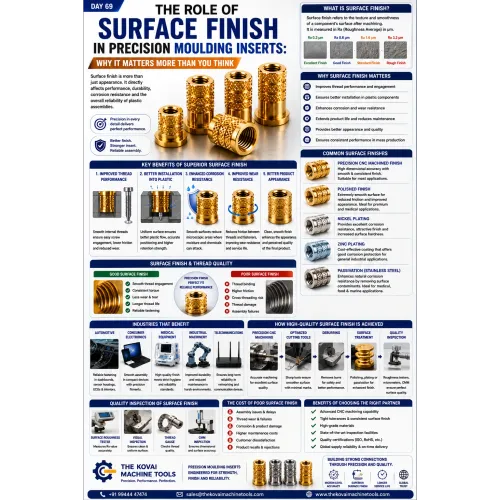
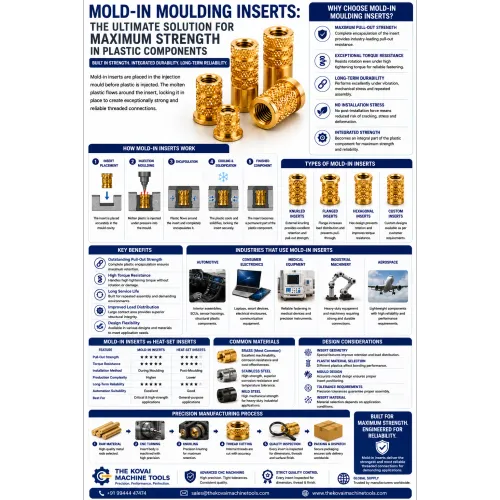
Knurling is a manufacturing process that creates a patterned surface on the outer diameter of a moulding insert.
These patterns are specifically designed to:
- Increase surface contact area
- Improve mechanical interlocking
- Enhance plastic flow around the insert
- Prevent insert rotation
- Increase pull-out resistance
The knurled surface creates a strong bond between the insert and the plastic component after installation.
Without knurling, the insert would have significantly lower retention strength and could loosen during use.
Why Retention Strength Matters
Retention strength refers to the insert's ability to remain securely fixed inside the plastic component under various forces.
During product operation, inserts may experience:
- Axial pull-out loads
- Rotational torque
- Vibration
- Thermal expansion and contraction
- Repeated assembly and disassembly
If retention strength is inadequate, the insert may:
- Rotate inside the plastic
- Pull out completely
- Damage surrounding material
- Cause product failure
A properly designed knurl significantly reduces these risks.
How Knurl Design Improves Insert Performance
1. Increases Mechanical Interlocking
The primary function of knurling is to create mechanical interlocking between the insert and plastic.
During installation:
- Plastic softens
- Material flows into knurl grooves
- Plastic solidifies around the pattern
This creates a strong bond that resists movement.
The deeper and more optimized the knurl design, the stronger the interlock.
2. Improves Pull-Out Resistance
Pull-out resistance is one of the most important performance criteria for moulding inserts.
A well-designed knurl increases:
- Surface engagement
- Frictional resistance
- Mechanical retention
This allows the insert to withstand higher extraction forces.
Applications exposed to vibration and mechanical loads particularly benefit from high pull-out strength.
3. Enhances Torque Resistance
When screws are tightened into threaded inserts, rotational forces are transferred to the insert body.
Poor retention can cause the insert to rotate inside the plastic.
Knurling prevents this by creating multiple locking points that resist rotational movement.
This improves fastening reliability and assembly quality.
4. Improves Load Distribution
Knurl patterns help distribute mechanical loads more evenly throughout the surrounding plastic material.
This reduces:
- Stress concentration
- Plastic deformation
- Cracking around the insert
Better load distribution leads to longer product life.
Common Knurl Patterns Used in Moulding Inserts
Different applications require different knurl geometries.
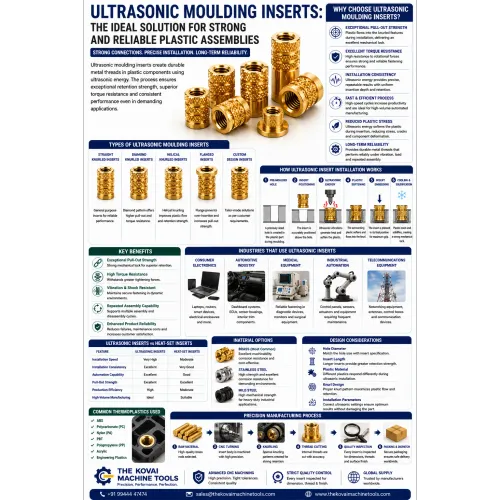
Straight Knurl
Straight knurls consist of parallel grooves running along the insert length.
Advantages
- Simple design
- Good axial retention
- Suitable for general-purpose applications
Common Applications
- Consumer products
- Electrical housings
- Basic plastic assemblies
Diamond Knurl
Diamond knurling features intersecting grooves forming a crisscross pattern.
Advantages
- Excellent pull-out resistance
- High torque resistance
- Strong mechanical interlocking
Common Applications
- Automotive components
- Medical equipment
- Industrial assemblies
Diamond knurling is one of the most widely used patterns for precision moulding inserts.
Helical Knurl
Helical knurling uses angled grooves wrapped around the insert body.
Advantages
- Improved installation flow
- Enhanced retention in specific plastics
- Good rotational resistance
Common Applications
- Specialized engineering applications
- High-performance plastic components
Combination Knurl Designs
Advanced moulding inserts often combine multiple knurl patterns.
These custom designs optimize:
- Pull-out strength
- Torque resistance
- Installation performance
Custom knurl geometries are increasingly common in high-end industrial applications.
Factors That Influence Knurl Performance
Knurl effectiveness depends on several factors.
Knurl Depth
Deeper knurls generally improve retention but must be balanced carefully.
Excessive depth may:
- Damage plastic during installation
- Create stress concentrations
Precision engineering is essential.
Knurl Pitch
Pitch refers to the spacing between knurl features.
Proper pitch helps maximize plastic flow and mechanical locking.
Knurl Angle
The angle of the knurl pattern affects:
- Rotational resistance
- Installation performance
- Plastic engagement
Different materials often require different knurl angles.
Insert Material
Material selection also influences knurl performance.
Common materials include:
Brass
Most popular due to:
- Excellent machinability
- Precise knurl formation
- Good corrosion resistance
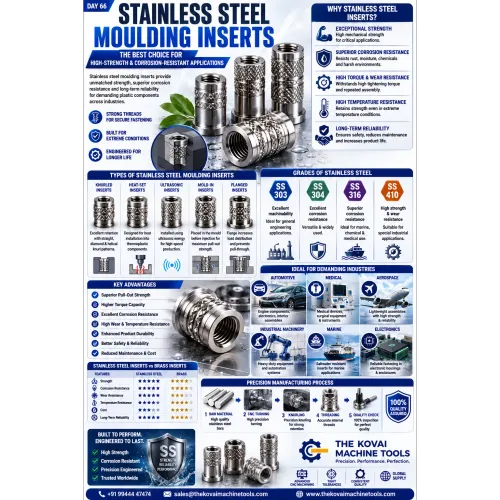
Stainless Steel
Offers:
- High strength
- Excellent durability
- Superior corrosion resistance
Mild Steel
Suitable for heavy-duty industrial applications.
Why Precision Machining Is Critical
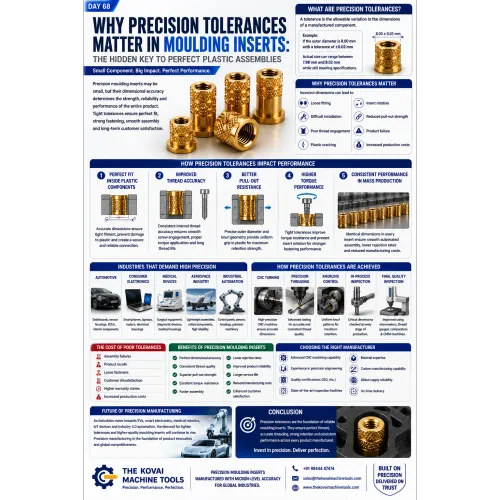
The effectiveness of a knurl pattern depends heavily on manufacturing accuracy.
Precision CNC machining ensures:
- Consistent knurl geometry
- Uniform depth
- Accurate spacing
- Repeatable performance
Poorly manufactured knurling can lead to:
- Reduced retention strength
- Installation problems
- Product failures
This is why high-quality moulding insert manufacturers invest heavily in advanced CNC technology.
Industries That Depend on Precision Knurl Design
Automotive Industry
Used in:
- Electronic modules
- Dashboard assemblies
- Sensor housings
- EV battery systems
Strong retention is essential due to vibration exposure.
Consumer Electronics
Applications include:
- Smartphones
- Laptops
- Networking devices
- Smart appliances
Miniaturized products require highly optimized knurling.
Medical Equipment
Medical devices demand:
- Precision assembly
- Long-term reliability
- Consistent performance
Knurl quality plays a major role.
Industrial Automation
Machinery and robotic systems require durable fastening solutions capable of handling heavy operating loads.
Future Trends in Knurl Design
As products become:
- Smaller
- Lighter
- More complex
Insert manufacturers are developing advanced knurl geometries to improve retention without increasing component size.
Emerging trends include:
- Optimized CNC-generated knurl profiles
- Application-specific retention designs
- Enhanced automation compatibility
- Improved performance for engineering plastics
The future of moulding inserts will continue to rely heavily on advanced knurl engineering.
Conclusion
Knurl design is one of the most important factors influencing moulding insert performance.
A properly engineered knurl pattern provides:
✔ Superior pull-out resistance
✔ Excellent torque resistance
✔ Improved load distribution
✔ Better vibration performance
✔ Longer product life
Whether using brass, stainless steel, or custom-engineered inserts, precision knurling ensures that the insert remains securely bonded to the plastic component throughout its service life.
For manufacturers seeking reliable fastening solutions, investing in high-quality precision knurled inserts is essential.
Call to Action
Looking for Precision Knurled Moulding Inserts, Brass Inserts, Stainless Steel Inserts, Heat-Set Inserts, or Custom CNC Turned Components?
The Kovai Machine Tools manufactures precision-engineered moulding inserts designed for maximum retention strength and long-term reliability.
Our Expertise Includes:
✅ Precision Knurled Inserts
✅ Brass Threaded Inserts
✅ Stainless Steel Inserts
✅ Heat-Set Inserts
✅ Ultrasonic Inserts
✅ Flanged Inserts
✅ Custom CNC Turned Components
✅ High-Volume Manufacturing Solutions
Keywords