The Role of Precision Moulding Inserts in Electric Vehicle (EV) Components
Introduction
The global automotive industry is undergoing one of the biggest transformations in its history. As governments, manufacturers, and consumers increasingly focus on sustainability and energy efficiency, Electric Vehicles (EVs) have become the future of transportation.
From passenger cars and commercial vehicles to electric two-wheelers and autonomous transportation systems, EV adoption is growing rapidly worldwide.
While much attention is given to batteries, motors, charging systems, and electronics, there is another critical component contributing to EV reliability and performance:
Precision Moulding Inserts
These small but highly engineered components play a significant role in ensuring strong fastening, structural integrity, and long-term durability in various EV systems.
Modern electric vehicles rely heavily on lightweight plastic and composite components to improve efficiency and extend driving range. However, these materials often require reinforced threaded connections to withstand repeated assembly, vibration, thermal cycling, and operational stresses.
This is where precision moulding inserts become essential.
In this article, we explore the role of moulding inserts in EV manufacturing, their applications, benefits, and why they are becoming increasingly important in next-generation electric mobility solutions.
Why Lightweight Design Matters in EVs
One of the primary goals of EV manufacturers is reducing vehicle weight.
Lighter vehicles offer:
- Extended battery range
- Improved energy efficiency
- Better performance
- Reduced manufacturing costs
- Enhanced vehicle dynamics
To achieve these goals, manufacturers increasingly replace traditional metal components with:
- Engineering plastics
- Composite materials
- Lightweight polymers
While these materials reduce weight, they often lack the thread strength required for secure fastening.
Precision moulding inserts solve this challenge by combining:
Lightweight Plastic Structures
with
Durable Metal Threaded Connections
This combination provides both strength and weight reduction.
What Are Precision Moulding Inserts?
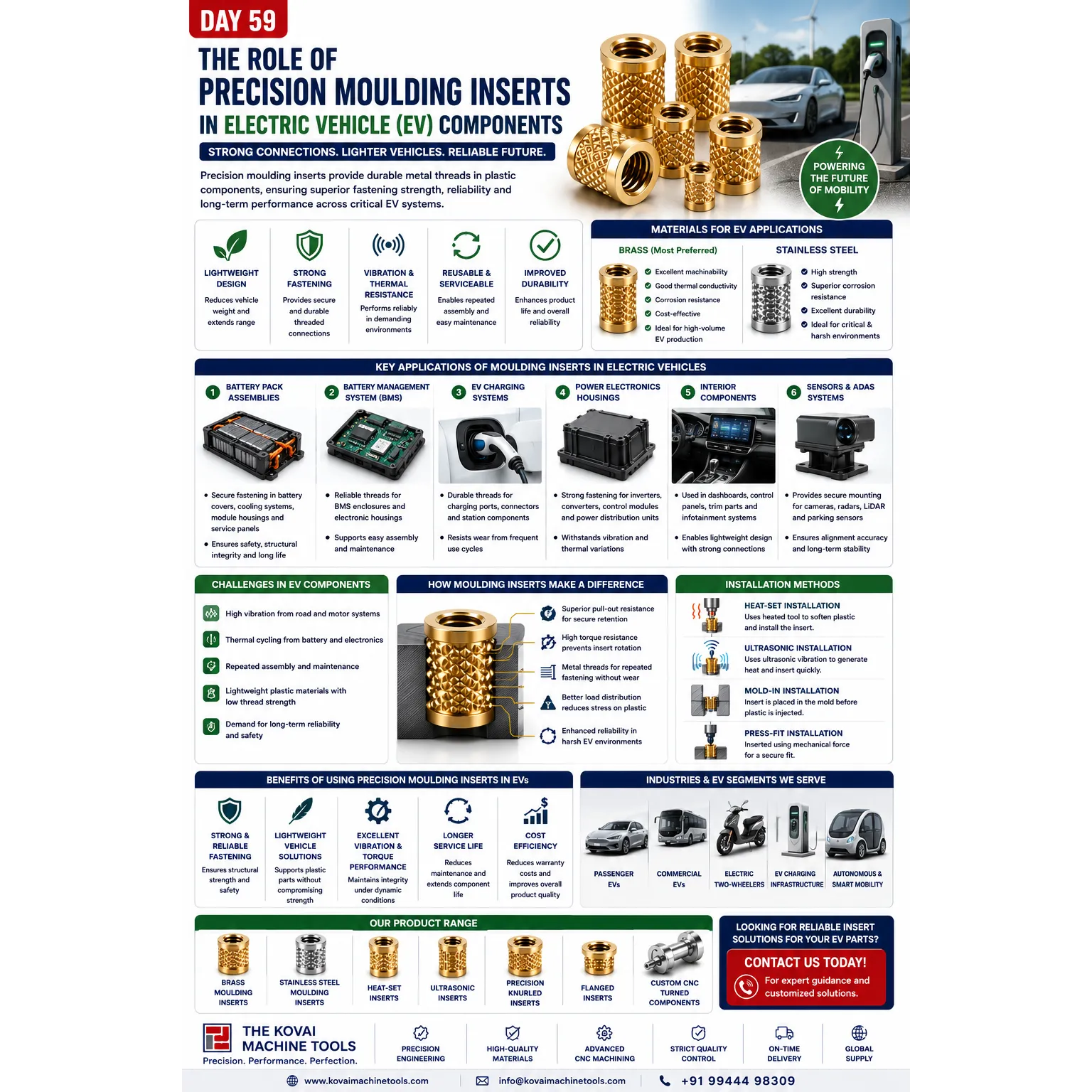
Precision moulding inserts are metal threaded components embedded into plastic or composite parts.
They provide:
- Durable internal threads
- Improved fastening strength
- Resistance to thread wear
- Enhanced torque performance
- Reusable fastening points
These inserts are commonly manufactured from:
- Brass
- Stainless Steel
- Special engineering alloys
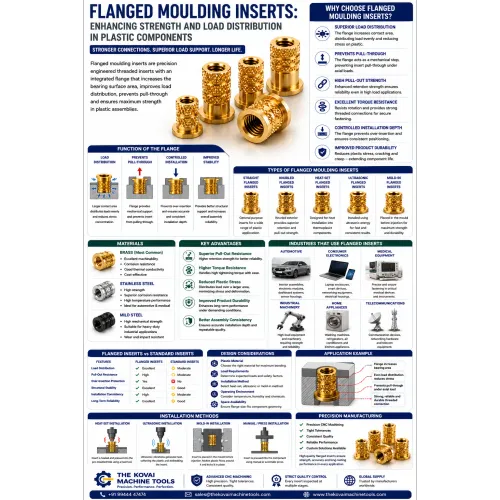
Depending on the application, inserts may be installed through:
- Heat-setting
- Ultrasonic insertion
- Mold-in placement
- Press-fit installation
Why EV Manufacturers Use Moulding Inserts
Electric vehicles contain thousands of fastened components.
Many of these parts require:
- Repeated assembly
- Maintenance access
- High vibration resistance
- Thermal stability
Plastic threads alone cannot reliably handle these demands.
Moulding inserts provide the strength and durability necessary for long-term vehicle performance.
Key Applications of Moulding Inserts in Electric Vehicles
1. Battery Pack Assemblies
Battery packs are among the most important components in an electric vehicle.
They contain:
- Battery modules
- Cooling systems
- Protective housings
- Monitoring electronics
Many battery pack structures use lightweight plastic and composite materials.
Precision moulding inserts provide secure threaded connections for:
- Battery covers
- Cooling components
- Sensor mounting
- Service access panels
Reliable fastening is critical for safety and performance.
2. Battery Management Systems (BMS)
The Battery Management System controls:
- Charging
- Temperature monitoring
- Voltage balancing
- Safety functions
BMS enclosures often use plastic housings to reduce weight.
Moulding inserts ensure:
- Secure assembly
- Easy maintenance access
- Long-term reliability
3. EV Charging Systems
Charging ports and charging station components experience frequent usage cycles.
Moulding inserts provide:
- Durable threads
- Wear resistance
- Strong fastening performance
This helps maintain charging system reliability throughout the vehicle's lifespan.
4. Power Electronics Housings
Electric vehicles contain advanced electronics such as:
- Inverters
- Converters
- Control modules
- Power distribution units
These systems require durable enclosures capable of withstanding vibration and temperature changes.
Precision inserts provide secure fastening while protecting sensitive electronics.
5. Interior Components
EV manufacturers increasingly use lightweight plastic assemblies for:
- Dashboard systems
- Control panels
- Infotainment systems
- Trim components
Moulding inserts improve fastening reliability and support repeated servicing.
6. Sensor and Autonomous Driving Systems
Modern EVs rely on numerous sensors including:
- Cameras
- Radar units
- LiDAR systems
- Parking sensors
These components require highly secure mounting systems.
Precision inserts help ensure alignment accuracy and long-term stability.
Challenges Faced by EV Components
Electric vehicle components are exposed to demanding operating conditions.
These include:
Vibration
Road conditions create continuous vibration loads.
Thermal Cycling
Battery systems generate heat and experience temperature fluctuations.
Repeated Maintenance
Service operations require frequent assembly and disassembly.
Lightweight Material Constraints
Plastic structures need reinforcement for threaded connections.
Moulding inserts help address all these challenges.
Benefits of Precision Moulding Inserts in EV Applications
Superior Thread Strength
Metal threads provide significantly greater durability than plastic threads.
This allows repeated fastening without wear.
Excellent Pull-Out Resistance
Knurled insert designs create strong mechanical interlocking with plastic materials.
This improves retention strength under vibration and load.
Improved Torque Performance
Precision inserts resist rotational movement during fastening operations.
This enhances assembly quality and long-term reliability.
Extended Component Life
Stronger fastening systems contribute to longer service life and reduced maintenance costs.
Lightweight Vehicle Design
Moulding inserts enable the use of lightweight plastics without sacrificing structural performance.
Why Brass Inserts Are Widely Used in EV Components
Brass remains one of the most popular materials for EV moulding inserts because it offers:
Excellent Machinability
Allows precise thread manufacturing.
Superior Thermal Conductivity
Supports heat-set installation processes.
Corrosion Resistance
Provides long-term durability.
Cost Efficiency
Balances performance and manufacturing cost.
These advantages make brass inserts ideal for high-volume EV production.
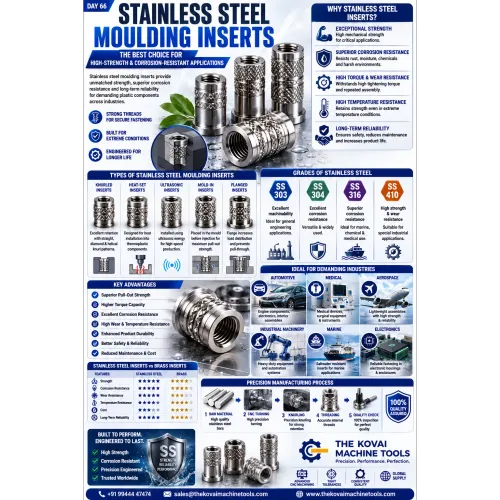
Stainless Steel Inserts for Critical EV Applications
Certain EV components require enhanced strength and corrosion resistance.
Stainless steel inserts are commonly used in:
- High-load assemblies
- Exterior systems
- Harsh operating environments
Benefits include:
- Exceptional durability
- Superior corrosion resistance
- Long service life
Importance of Precision Manufacturing in EV Components
Electric vehicle manufacturers demand extremely high quality standards.
Precision moulding inserts must feature:
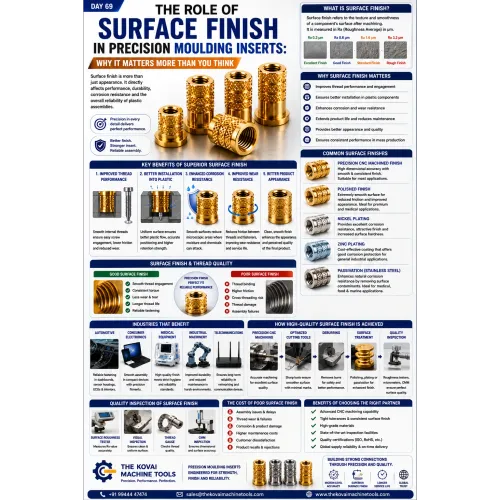
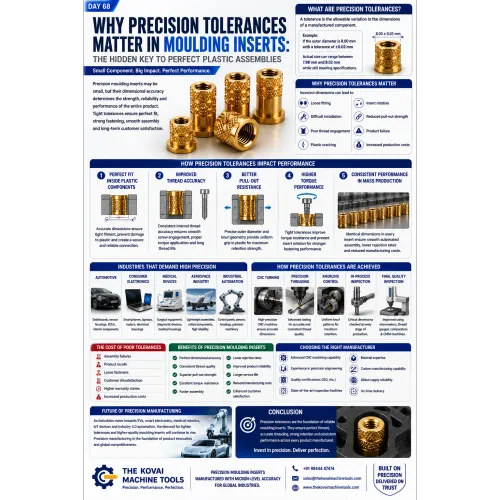
Accurate Threads
For reliable fastener engagement.
Consistent Knurling
For maximum retention strength.
Tight Tolerances
To support automated assembly.
Reliable Material Quality
To ensure long-term durability.
Advanced CNC machining technology enables these requirements.
Future Growth of EV Moulding Insert Demand
The rapid expansion of the EV industry is increasing demand for precision fastening solutions.
Growth drivers include:
- Electric passenger vehicles
- Commercial EV fleets
- Electric two-wheelers
- Autonomous vehicles
- Smart mobility systems
As vehicle designs become lighter and more technologically advanced, moulding inserts will play an even more important role.
Why Global EV Manufacturers Prioritize Insert Quality
Poor-quality inserts can lead to:
- Assembly failures
- Service issues
- Increased warranty claims
- Safety concerns
High-quality precision inserts help manufacturers achieve:
✔ Better reliability
✔ Longer component life
✔ Improved production efficiency
✔ Higher customer satisfaction
For EV manufacturers, insert quality is not just a component issue—it is a product performance issue.
Conclusion
Precision moulding inserts have become an essential part of modern electric vehicle manufacturing.
Their ability to provide:
- Strong metal threads
- Superior retention strength
- Reliable fastening performance
- Long-term durability
makes them indispensable for EV battery systems, electronics, charging infrastructure, sensor modules, and lightweight structural assemblies.
As the electric vehicle industry continues to expand globally, the demand for high-quality precision moulding inserts will continue to grow.
Manufacturers seeking reliable, lightweight, and durable fastening solutions will increasingly depend on precision-engineered inserts to meet future mobility challenges.
Call to Action
Looking for Precision Moulding Inserts for EV Components, Automotive Applications, Electronics, and Industrial Systems?
The Kovai Machine Tools manufactures world-class precision moulding inserts trusted by global industries.
Our Product Range Includes:
✅ Brass Moulding Inserts
✅ Stainless Steel Inserts
✅ Heat-Set Inserts
✅ Ultrasonic Inserts
✅ Precision Knurled Inserts
✅ Flanged Inserts
✅ EV Component Inserts
✅ Custom CNC Turned Components
✅ High-Volume Manufacturing Solutions
📞 Contact us today to discuss your EV component requirements and receive a customized engineering solution.
Partner with a trusted precision manufacturing expert and power the future of electric mobility with high-performance moulding inserts engineered for reliability and durability. 🚗⚡🚀
Keywords