Thread Quality Matters in Precision Moulding Inserts
Introduction
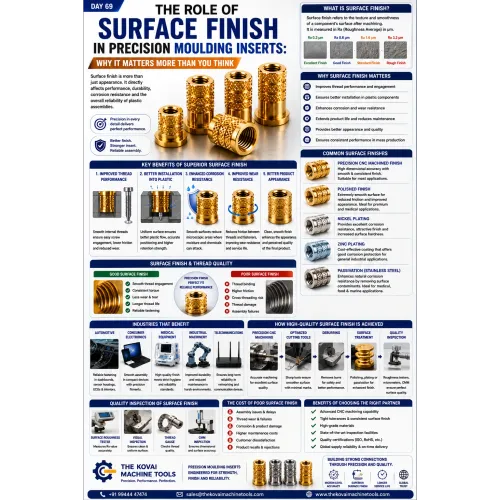
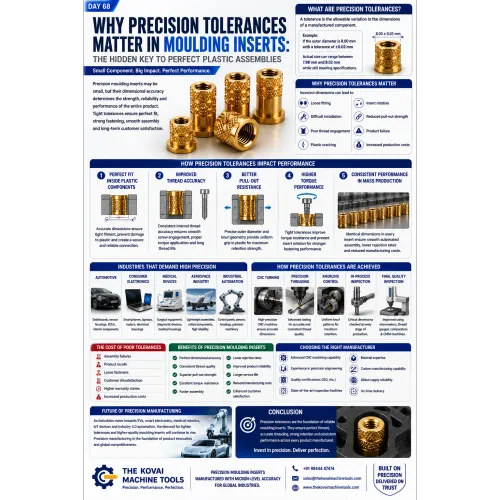
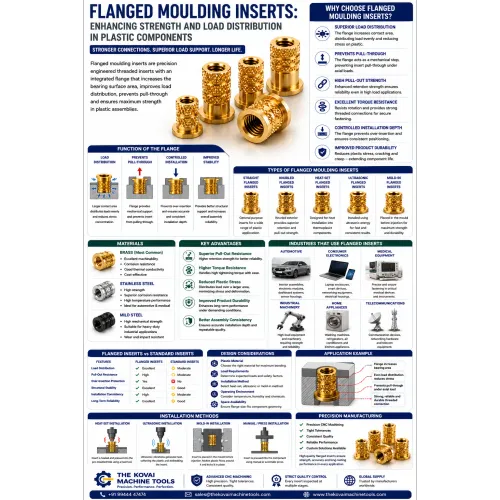
In the manufacturing world, even the smallest component can determine the success or failure of an entire product. One such component is the precision moulding insert. While manufacturers often focus on material selection, knurling design, and installation methods, one critical factor is frequently overlooked:
Thread Quality
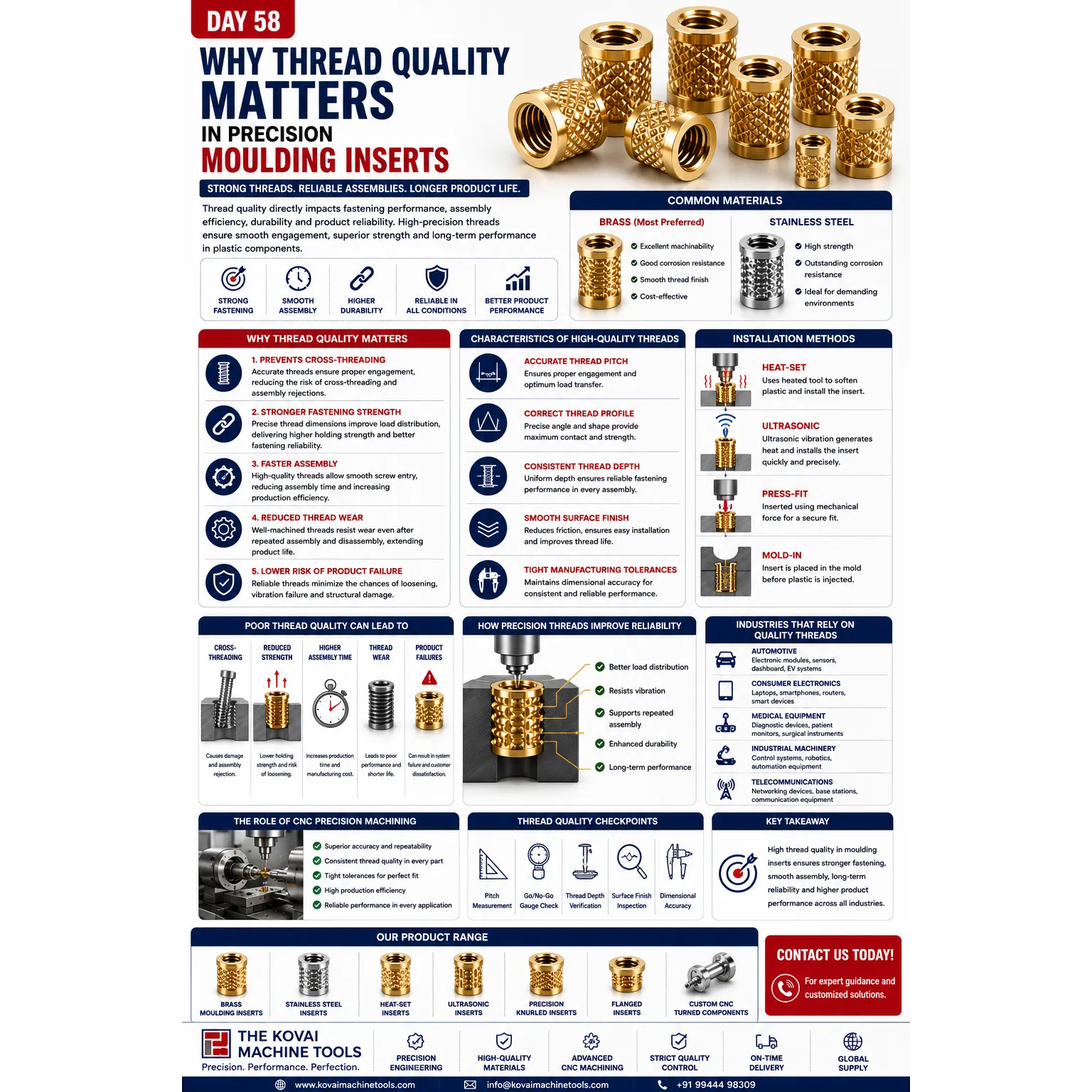
The quality of threads in a moulding insert directly impacts fastening performance, assembly efficiency, durability, and product reliability.
A perfectly machined insert with poor thread quality can lead to:
- Fastener misalignment
- Cross-threading
- Assembly delays
- Product failures
- Increased maintenance costs
On the other hand, high-quality threads ensure smooth assembly, strong fastening, and long-term performance.
Whether used in automotive electronics, medical devices, industrial equipment, telecommunications systems, or consumer products, precision moulding inserts must deliver flawless thread performance throughout the product's lifespan.
In this article, we will explore why thread quality is essential, how it affects product performance, and what manufacturers should consider when selecting moulding inserts.
What Is Thread Quality?
Thread quality refers to the accuracy and consistency of the threaded profile inside a moulding insert.
A high-quality thread must have:
- Accurate thread pitch
- Correct thread angle
- Proper thread depth
- Smooth surface finish
- Consistent dimensions
- Tight manufacturing tolerances
These characteristics ensure proper engagement between the insert and the fastener.
When thread quality is poor, fastening performance suffers significantly.
Why Threads Are Critical in Moulding Inserts
The primary function of a moulding insert is to provide a durable metal thread inside a plastic component.
Every fastening force passes through these threads.
The thread system must withstand:
- Tightening torque
- Mechanical loads
- Vibration
- Repeated assembly cycles
- Environmental stress
Without precise threads, the insert cannot perform its intended function effectively.
How Poor Thread Quality Affects Product Performance
1. Cross-Threading Issues
Cross-threading occurs when a fastener enters the insert incorrectly.
Poorly machined threads increase the likelihood of:
- Misalignment
- Thread damage
- Assembly rejection
This can lead to production delays and increased costs.
2. Reduced Fastening Strength
Thread engagement determines how securely a screw locks into an insert.
Inaccurate threads may:
- Reduce holding strength
- Create uneven load distribution
- Cause premature loosening
As a result, product reliability decreases.
3. Higher Assembly Time
Assembly operators and automated systems rely on smooth thread engagement.
Poor thread quality can cause:
- Screw jamming
- Repeated installation attempts
- Production slowdowns
This negatively impacts manufacturing efficiency.
4. Increased Thread Wear
Low-quality threads wear out faster during repeated use.
This reduces:
- Service life
- Maintenance intervals
- Product durability
High-quality threads ensure long-term performance even under frequent assembly and disassembly.
5. Product Failure Risks
In critical applications such as automotive systems and medical devices, thread failure can result in serious operational problems.
Reliable thread quality minimizes these risks and improves overall safety.
Characteristics of High-Quality Threads
Accurate Thread Pitch
Thread pitch refers to the distance between adjacent thread peaks.
Precision pitch ensures:
- Proper fastener engagement
- Smooth installation
- Reliable load transfer
Even small pitch variations can create fastening problems.
Correct Thread Profile
The shape of the thread must match engineering specifications.
This ensures:
- Maximum contact area
- Better load distribution
- Stronger fastening performance
Consistent Thread Depth
Uniform thread depth improves:
- Screw engagement
- Torque performance
- Fastening strength
Consistency is critical for mass production environments.
Smooth Surface Finish
A smooth thread finish reduces friction during installation.
Benefits include:
- Easier assembly
- Reduced wear
- Improved thread life
Tight Manufacturing Tolerances
Precision inserts are manufactured within strict dimensional limits.
This ensures:
- Consistent performance
- Better interchangeability
- Reliable automated assembly
Why CNC Machining Is Essential for Thread Quality
Modern precision moulding inserts are manufactured using advanced CNC machining technology.
CNC machining provides:
Superior Accuracy
Threads are produced according to exact specifications.
Repeatability
Every insert maintains the same thread quality.
Tight Tolerances
Critical dimensions remain highly consistent.
High Production Efficiency
Large production volumes can maintain identical quality standards.
These advantages make CNC machining the preferred manufacturing method for precision moulding inserts.
Thread Quality and Automated Manufacturing
Modern production lines increasingly rely on automation.
Automated assembly systems require:
- Consistent insert dimensions
- Reliable thread engagement
- Minimal installation errors
Poor thread quality can disrupt automated processes and increase rejection rates.
High-quality moulding inserts support:
✔ Faster assembly
✔ Lower production costs
✔ Improved process reliability
✔ Reduced downtime
Thread Quality in Different Industries
Automotive Industry
Automotive components require strong fastening performance under vibration and thermal cycling.
Applications include:
- Sensor housings
- Dashboard assemblies
- Electronic modules
- EV battery systems
Thread quality is essential for long-term reliability.
Medical Equipment
Medical devices demand:
- Precision assembly
- Consistent performance
- High safety standards
Thread failures are unacceptable in critical healthcare applications.
Consumer Electronics
Devices such as laptops, routers, and smart products require repeated assembly and servicing.
Precision threads ensure long-lasting durability.
Industrial Machinery
Industrial equipment often operates under heavy mechanical loads.
Strong thread engagement helps maintain reliable operation.
Brass vs Stainless Steel Thread Performance
Material selection also influences thread quality.
Brass Inserts
Advantages:
- Excellent machinability
- Highly precise threads
- Smooth surface finish
- Cost-effective production
Brass remains the most popular material for moulding inserts.
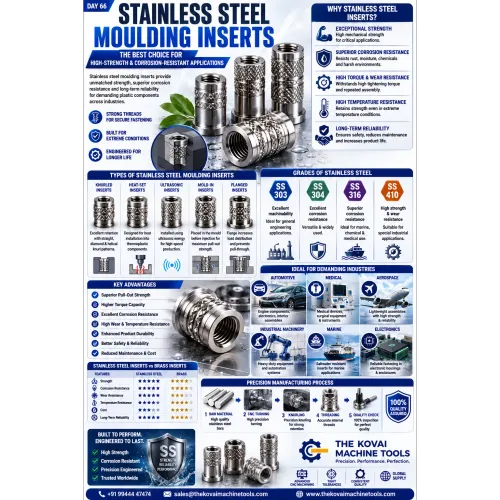
Stainless Steel Inserts
Advantages:
- High strength
- Superior durability
- Excellent corrosion resistance
Ideal for demanding industrial environments.
Both materials can provide outstanding thread quality when manufactured correctly.
How Precision Moulding Inserts Improve Product Reliability
High-quality threads provide several important benefits:
Better Fastening Strength
More secure connections.
Improved Product Life
Reduced wear and maintenance.
Consistent Assembly
Reliable performance during production.
Enhanced Customer Satisfaction
Fewer failures and warranty claims.
These benefits contribute directly to product quality and brand reputation.
What Buyers Should Look for in a Moulding Insert Supplier
When evaluating suppliers, manufacturers should consider:
CNC Manufacturing Capability
Can the supplier consistently produce accurate threads?
Quality Control Systems
Are threads inspected and verified?
Material Expertise
Do they offer brass, stainless steel, and custom materials?
Industry Experience
Do they understand application-specific requirements?
Choosing the right supplier is essential for achieving reliable thread performance.
Future Trends in Precision Thread Manufacturing
As products become:
- Smaller
- More complex
- More automated
Thread quality requirements continue to increase.
Future developments include:
- Advanced CNC threading technology
- Automated inspection systems
- Micro-thread manufacturing
- Enhanced quality control processes
Precision threading will remain a critical factor in moulding insert performance.
Conclusion
Thread quality is one of the most important factors affecting the performance of precision moulding inserts.
High-quality threads provide:
✔ Strong fastening performance
✔ Smooth assembly
✔ Longer product life
✔ Improved reliability
✔ Reduced maintenance costs
From automotive and medical applications to industrial machinery and consumer electronics, precision thread manufacturing helps ensure that products perform reliably throughout their service life.
Investing in high-quality moulding inserts with precision-engineered threads is essential for achieving superior product durability and customer satisfaction.
Call to Action
Looking for Precision Moulding Inserts with Superior Thread Quality?
The Kovai Machine Tools manufactures high-precision moulding inserts engineered for exceptional thread accuracy and long-term performance.
Our Expertise Includes:
✅ Brass Moulding Inserts
✅ Stainless Steel Inserts
✅ Heat-Set Inserts
✅ Ultrasonic Inserts
✅ Precision Knurled Inserts
✅ Flanged Inserts
✅ Custom CNC Turned Components
✅ High-Volume Manufacturing Solutions
📞 Contact us today to discuss your project requirements and receive a customized quotation.
Partner with a trusted precision engineering manufacturer and experience stronger fastening, smoother assembly, and superior product reliability with world-class moulding inserts. 🚀
Keywords