
Ultrasonic Inserts vs Heat-Set Inserts: Which Fastening Solution Is Better for Plastic Components?
Introduction
In the world of plastic component manufacturing, creating strong and reliable threaded connections is one of the biggest challenges engineers face. Plastic materials offer excellent advantages such as lightweight construction, corrosion resistance, design flexibility, and cost-effective production. However, plastic alone often lacks the strength required for repeated fastening and heavy mechanical loads.
This is why moulding inserts have become an essential component in modern manufacturing.
Among the various installation methods available, Ultrasonic Inserts and Heat-Set Inserts are the two most widely used solutions for embedding threaded metal inserts into plastic parts.
Both methods are designed to provide:
- Strong internal threads
- Enhanced pull-out resistance
- Improved torque performance
- Longer product life
However, each technology offers unique advantages and is better suited for specific applications.
For product designers, engineers, and procurement teams, understanding the differences between ultrasonic inserts and heat-set inserts is critical for selecting the right fastening solution.
In this article, we will compare Ultrasonic Inserts vs Heat-Set Inserts, explain their working principles, benefits, limitations, and help you determine which option is best for your plastic component application.
Why Plastic Components Need Threaded Inserts
Plastic materials are increasingly replacing metal in industries such as:
- Automotive
- Consumer Electronics
- Medical Devices
- Telecommunications
- Industrial Equipment
- Home Appliances
While plastic components reduce weight and manufacturing costs, plastic threads can easily wear out or strip under repeated use.
Moulding inserts solve this problem by providing:
✔ Durable metal threads
✔ Improved fastening strength
✔ Higher load capacity
✔ Better product reliability
Among the most common installation methods are heat-setting and ultrasonic insertion.
What Are Heat-Set Inserts?
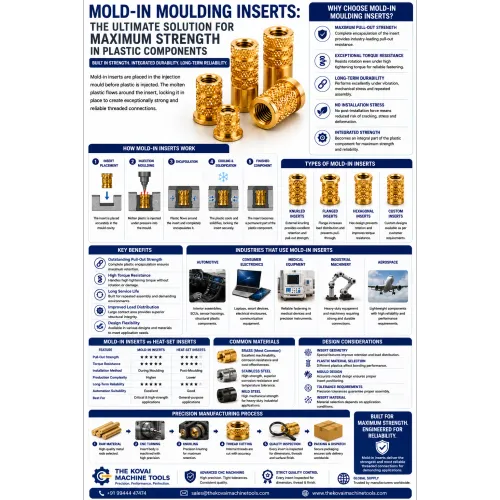
Heat-set inserts are metal threaded inserts installed using controlled heat.
During installation:
- A heated tool warms the insert.
- The surrounding plastic softens.
- The insert is pressed into the prepared hole.
- The plastic flows around the insert's knurling.
- The material cools and solidifies.
This creates a strong mechanical bond between the insert and the plastic component.
Key Features of Heat-Set Inserts
Excellent Retention Strength
The softened plastic fills the knurled features of the insert, creating superior pull-out resistance.
Strong Torque Resistance
Heat-set inserts resist rotation during fastening.
Reliable Long-Term Performance
Suitable for repeated assembly and disassembly cycles.
Cost-Effective Installation
Requires relatively simple equipment.
Common Applications of Heat-Set Inserts
Heat-set inserts are widely used in:
- Consumer electronics
- Electrical enclosures
- Medical equipment
- Household appliances
- Industrial plastic components
They are particularly effective for thermoplastic materials.
What Are Ultrasonic Inserts?
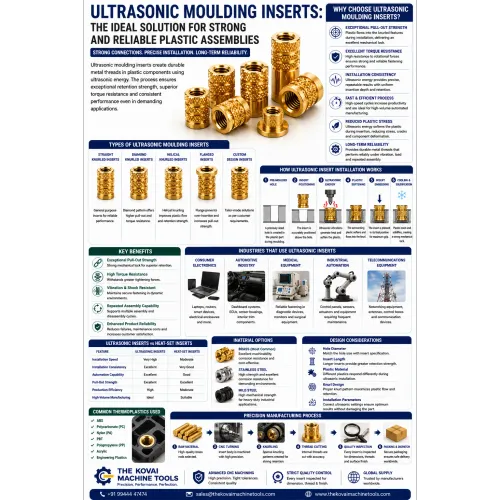
Ultrasonic inserts are installed using ultrasonic vibration technology.
Instead of relying solely on external heat, ultrasonic equipment generates high-frequency vibrations.
These vibrations create localized frictional heat at the interface between the insert and plastic.
During installation:
- The insert is positioned above the hole.
- Ultrasonic vibrations generate localized heat.
- The plastic softens rapidly.
- The insert is pressed into place.
- The plastic solidifies around the insert.
The result is a highly secure threaded connection.
Key Features of Ultrasonic Inserts
Rapid Installation
Ultrasonic insertion is extremely fast.
Precise Energy Application
Heat is generated only where needed.
Reduced Plastic Stress
The surrounding material experiences minimal thermal exposure.
Excellent Automation Compatibility
Ideal for high-volume production environments.
Common Applications of Ultrasonic Inserts
Ultrasonic inserts are commonly found in:
- Automotive electronics
- Telecommunications equipment
- Consumer devices
- Precision plastic assemblies
- High-volume manufacturing operations
Heat-Set Inserts vs Ultrasonic Inserts: Installation Comparison
Heat-Set Installation
Process
Uses externally heated tools.
Advantages
- Simple equipment
- Lower investment cost
- Suitable for small and medium production volumes
Limitations
- Slightly slower installation
- Greater heat transfer into surrounding plastic
Ultrasonic Installation
Process
Uses ultrasonic vibrations to generate localized heat.
Advantages
- Faster cycle times
- High precision
- Ideal for automated production
Limitations
- Higher equipment cost
- Requires specialized machinery
Comparison of Performance Characteristics
FeatureHeat-Set InsertsUltrasonic InsertsPull-Out StrengthExcellentExcellentTorque ResistanceExcellentExcellentInstallation SpeedModerateVery FastAutomation CapabilityGoodExcellentEquipment CostLowerHigherProduction Volume SuitabilityMedium to HighHigh to Very HighPlastic StressLowVery LowPrecision InstallationGoodExcellentWhich Method Provides Better Retention?
Both methods provide excellent retention when properly installed.
However:
Heat-Set Inserts
Often provide slightly deeper plastic flow around knurling features.
Ultrasonic Inserts
Provide highly controlled insertion with excellent consistency.
In practical applications, both methods can achieve outstanding pull-out and torque performance.
The choice often depends more on production requirements than retention strength alone.
Factors to Consider When Choosing Between Heat-Set and Ultrasonic Inserts
1. Production Volume
Lower to Medium Production
Heat-set inserts are often more economical.
High-Volume Manufacturing
Ultrasonic insertion becomes more attractive due to faster cycle times.
2. Automation Requirements
For highly automated production lines, ultrasonic insertion offers superior compatibility.
3. Budget Considerations
Heat-set equipment generally requires lower initial investment.
Ultrasonic systems involve higher upfront costs but can improve production efficiency.
4. Plastic Material
Certain engineering plastics respond differently to installation methods.
Material testing is recommended when evaluating insert options.
5. Product Complexity
Precision electronic assemblies often benefit from ultrasonic insertion due to controlled heat generation.
Why Brass Inserts Are Commonly Used in Both Methods
Brass remains the preferred material for both heat-set and ultrasonic inserts because it offers:
Excellent Thermal Conductivity
Supports efficient heat transfer.
Superior Machinability
Allows precision thread and knurl production.
Corrosion Resistance
Provides long service life.
Cost Efficiency
Balances performance and affordability.
These advantages make brass the most widely used material for moulding inserts worldwide.
Industries Using Heat-Set and Ultrasonic Inserts
Automotive Industry
Used in:
- Dashboard assemblies
- Electronic modules
- Sensor housings
- EV battery systems
Consumer Electronics
Applications include:
- Smartphones
- Laptops
- Smart devices
- Networking equipment
Medical Equipment
Precision fastening is critical for:
- Diagnostic devices
- Healthcare instruments
- Laboratory equipment
Industrial Automation
Machinery and control systems require durable threaded connections.
Future Trends in Plastic Fastening Technology
As industries continue to pursue:
- Lightweight designs
- Automation
- Miniaturization
- Smart products
Demand for advanced insert technologies will continue growing.
Both heat-set and ultrasonic inserts will remain essential solutions for high-performance plastic assemblies.
Conclusion
Both Heat-Set Inserts and Ultrasonic Inserts provide reliable, high-strength threaded connections in plastic components.
Choose Heat-Set Inserts when:
✔ Cost-effective installation is important
✔ Production volumes are moderate
✔ Simpler equipment is preferred
Choose Ultrasonic Inserts when:
✔ High-speed production is required
✔ Automation is critical
✔ Maximum installation consistency is needed
The best solution depends on your product design, production requirements, and long-term performance goals.
By selecting the right insert technology, manufacturers can significantly improve product reliability, durability, and assembly efficiency.
Call to Action
Looking for Precision Heat-Set Inserts, Ultrasonic Inserts, Brass Threaded Inserts, or Custom Moulding Inserts?
The Kovai Machine Tools manufactures high-quality precision moulding inserts trusted by industries worldwide.
Our Product Range Includes:
✅ Brass Heat-Set Inserts
✅ Ultrasonic Inserts
✅ Stainless Steel Inserts
✅ Knurled Inserts
✅ Flanged Inserts
✅ Custom CNC Turned Components
✅ Precision Threaded Inserts
✅ High-Volume Manufacturing Solution
Keywords