
Why Injection Moulded Plastic Products Need Metal Inserts
Introduction
Plastic injection moulding is one of the most widely used manufacturing processes in modern industries. From automotive components and consumer electronics to home appliances and industrial equipment, injection moulded plastic parts are everywhere.
Plastic offers several advantages such as lightweight construction, corrosion resistance, cost-effective production, and design flexibility. However, despite these benefits, plastic materials have one important limitation — they are not always strong enough to handle threaded fastening or repeated mechanical stress.
This is where metal inserts become essential.
Metal inserts are precision-machined components embedded into plastic parts to provide strong threads and structural reinforcement. These inserts significantly improve the strength, durability, and reliability of injection moulded products.
In this article, we will explore why injection moulded plastic products require metal inserts, how they improve performance, and why they have become a critical component in modern manufacturing.
Understanding Injection Moulded Plastic Components
Injection moulding is a manufacturing process where molten plastic is injected into a mould cavity to form a desired shape. Once cooled and solidified, the plastic part is ejected from the mould.
This process allows manufacturers to produce large volumes of complex parts with excellent consistency and efficiency.
Common plastics used in injection moulding include:
- ABS
- Nylon (PA)
- Polycarbonate (PC)
- Polypropylene (PP)
- PEEK and other engineering plastics
These materials are widely used because they offer good strength, flexibility, and resistance to chemicals and corrosion.
However, when it comes to threaded connections and mechanical fastening, plastic alone often cannot provide the required durability.
The Problem with Plastic Threads
When screws or bolts are fastened directly into plastic, several problems can occur.
Thread Stripping
Plastic threads can easily strip when screws are tightened with high torque or when the component is assembled repeatedly.
Once the threads are damaged, the connection becomes weak and unreliable.
Limited Strength
Plastic materials are softer than metals, which means they cannot withstand high mechanical loads.
Under stress, plastic threads may deform, crack, or break.
Wear from Repeated Assembly
Many products require maintenance or periodic disassembly.
If screws are repeatedly tightened into plastic threads, the material gradually wears out, reducing the strength of the connection.
Temperature Sensitivity
Plastic materials expand and contract when exposed to temperature changes. This can cause threaded connections to loosen over time.
What Are Metal Inserts?
Metal inserts are precision-machined metal components installed inside plastic parts to provide strong internal threads.
These inserts are typically made from materials such as:
- Brass
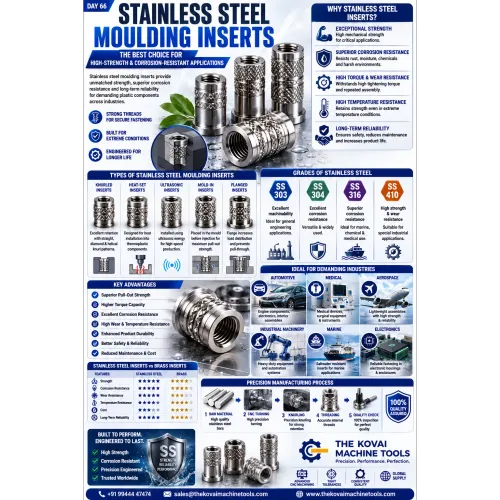
- Stainless steel
- Mild steel
- Aluminium
They are designed to bond securely with plastic components, allowing screws and bolts to be fastened reliably.
Once installed, the insert becomes a permanent reinforcement within the plastic part.
How Metal Inserts Improve Plastic Products
Metal inserts solve many of the limitations associated with plastic threads. Their integration into injection moulded components significantly improves performance.
1. Strong and Durable Threads
One of the main benefits of metal inserts is that they provide strong metal threads inside plastic parts.
This allows screws and bolts to be tightened securely without damaging the surrounding plastic material.
As a result, the connection becomes much more reliable.
2. Higher Torque Resistance
Plastic threads cannot handle high tightening torque. Metal inserts, however, allow fasteners to be tightened with greater force without risk of thread damage.
This is particularly important in applications where components must remain firmly secured.
3. Longer Product Life
Products that rely on plastic threads may fail prematurely due to thread wear.
Metal inserts provide durable threads that can withstand repeated assembly cycles, increasing the lifespan of the product.
4. Improved Load Distribution
When screws are tightened into plastic, the load is concentrated in a small area. Over time, this can cause cracking or deformation.
Metal inserts distribute the load more evenly, reducing stress on the plastic component.
This improves both strength and structural integrity.
5. Reliable Assembly
Manufacturers need consistent assembly during production.
Metal inserts ensure that:
- Screws align properly
- Threads engage smoothly
- Fasteners remain secure
This improves production efficiency and reduces assembly errors.
Methods of Installing Metal Inserts in Plastic
There are several techniques used to install metal inserts into injection moulded parts.
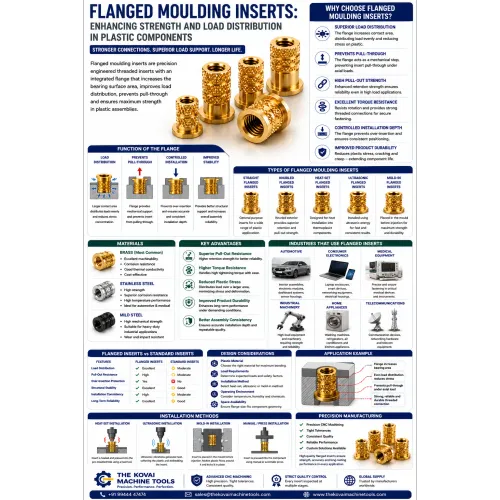
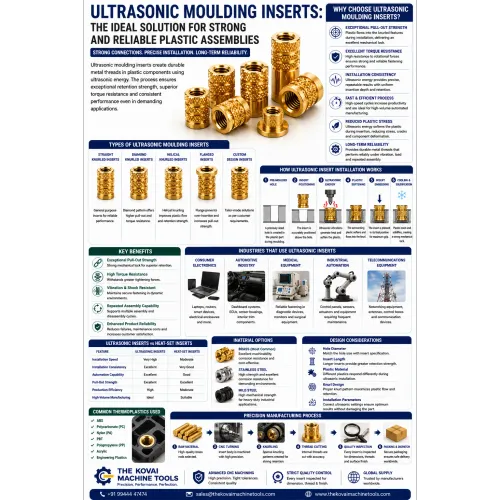
Press-Fit Inserts
Press-fit inserts are installed by applying pressure to push the insert into a hole in the plastic component.
These inserts are designed with knurled surfaces that grip the plastic securely.
Heat-Set Inserts
Heat-set inserts are installed using heat to soften the plastic around the insert.
Once the plastic cools, it locks the insert firmly in place.
This method provides strong bonding and excellent durability.
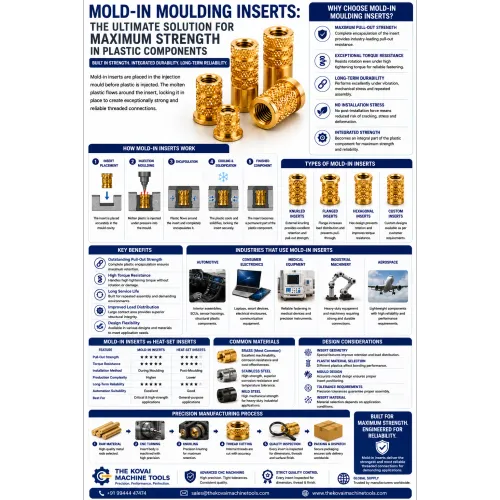
Mold-In Inserts
Mold-in inserts are placed inside the mould before the injection moulding process begins.
The plastic is then injected around the insert, embedding it directly into the part.
This method provides maximum strength and stability.
Industries That Depend on Metal Inserts
Metal inserts are widely used across many industries where plastic components require strong threaded connections.
Automotive Industry
Automotive manufacturers use metal inserts in plastic components such as dashboards, sensor housings, and control modules.
These inserts provide reliable fastening even under vibration and mechanical stress.
Consumer Electronics
Electronic devices rely on plastic enclosures that require strong and durable threaded connections.
Metal inserts ensure that screws can be tightened repeatedly during assembly and maintenance.
Industrial Machinery
Machinery manufacturers use metal inserts to reinforce plastic components used in equipment and assemblies.
Home Appliances
Appliances such as washing machines, air conditioners, and kitchen equipment use plastic housings reinforced with metal inserts for reliable fastening.
Importance of Precision Manufacturing
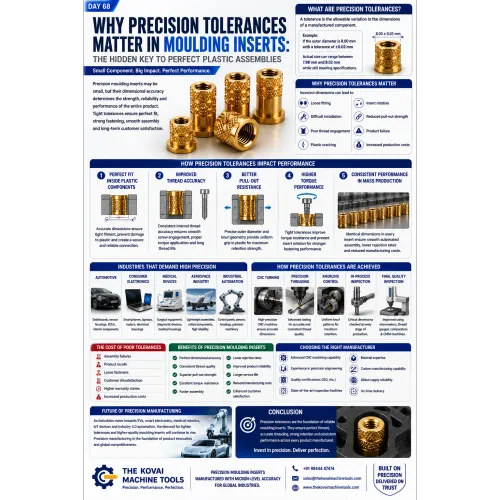
The performance of metal inserts depends heavily on precision manufacturing.
High-quality inserts must be produced with:
- Accurate thread profiles
- Tight dimensional tolerances
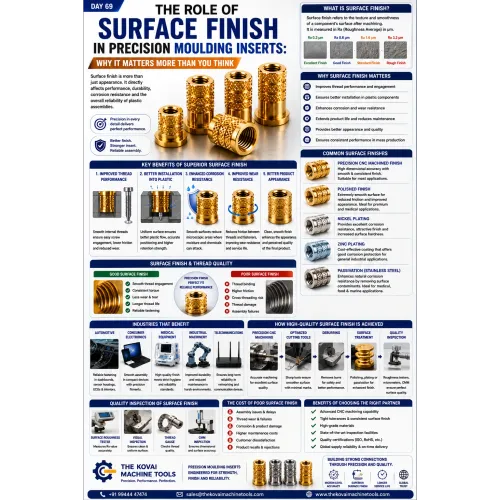
- Smooth surface finishes
- Consistent quality
Precision machining processes such as CNC turning are commonly used to manufacture inserts that meet strict engineering requirements.
Poorly manufactured inserts can lead to problems such as misalignment, weak fastening, or assembly issues.
The Growing Importance of Metal Inserts
As industries continue to demand lighter and more efficient products, plastic components are becoming increasingly common.
However, to ensure durability and reliability, these plastic parts often require reinforcement.
Metal inserts provide the perfect solution by combining the advantages of plastic with the strength of metal.
This is why metal inserts are widely used in modern product design across multiple industries.
Conclusion
Plastic injection moulding is an efficient and versatile manufacturing process, but plastic components alone may not provide the strength required for reliable threaded fastening.
Metal inserts solve this challenge by reinforcing plastic parts with durable metal threads.
They improve product strength, increase torque resistance, enhance durability, and ensure reliable assembly.
As a result, metal inserts have become an essential component in industries such as automotive, electronics, industrial equipment, and appliance manufacturing.
By integrating precision moulding inserts into plastic products, manufacturers can achieve better performance, longer product life, and improved reliability.
Call to Action
If your products require strong and reliable threaded connections in plastic components, choosing the right precision moulding insert supplier is essential.
The Kovai Machine Tools manufactures high-quality precision moulding inserts, rivets, bushes, shafts, and CNC turned components designed to meet the demands of modern industries.
Our expertise in precision machining and high-quality materials ensures that every component delivers accuracy, durability, and dependable performance.
📞 Contact us today to discuss your requirements or request a quotation for precision moulding inserts tailored to your application.
Partner with a trusted precision component manufacturer and strengthen your products with reliable metal inserts. 🚀
Keywords